

solutionS / Healthcare functions
Appeals & Grievances
Facing challenges in managing appeals and grievances efficiently? Automate case management and drive regulatory compliance for quick resolutions that enhance member experience and operational effectiveness.
Value to your organization
 Strong compliance posture
- Faster resolutions
- Cost reductions
 Strong compliance posture
Benefits we bring
- Automated case management
- Faster resolution times
- Enhanced member satisfaction
Heathplan functions / Compliance and Audit
Automate compliance and streamline audits
Automate critical tasks such as tracking, reporting, and data validation, ensuring your organization stays compliant with minimal effort. With real-time dashboards and audit trails, your team can focus on strategic initiatives while reducing the risk of penalties and audit failures.
Value to your organization
- Automate compliance tracking
- Streamline audit processes
- Reduce audit costs and effort
Benefits we bring
- Automated compliance tracking
- Reduced manual audit effort
- Improved audit
readiness
- Minimized compliance risks
Heathplan functions / Delegation oversight
Centralize oversight for compliance and performance
Centralize your delegation oversight process with tools like the Delegate Repository, automated evaluations, and built-in compliance monitoring. By streamlining oversight, your organization can ensure all delegates meet regulatory requirements while improving overall performance and accountability.
Value to your organization
- Centralize delegate information
- Streamline delegate evaluations
- Enhance audit readiness
Benefits we bring
- Centralized delegate management
- Automated performance evaluations
- Real-time compliance monitoring
- Efficient corrective action tracking
Heathplan functions / IT
Enhance IT efficiency with scalable, secure solutions
Empower your IT department with scalable, secure, and compliant infrastructure. With HIPAA-compliant security protocols and automated compliance monitoring, your IT function can focus on innovation while ensuring regulatory adherence and operational efficiency.
Value to your organization
- Enhance security and compliance
- System reliability and scalability
- Streamline system integration
Benefits we bring
- Seamless system integration
- Scalable cloud infrastructure
- Enhanced security protocols
- Faster app
development
helathplan functions / Member services
Boost member satisfaction with faster, personalized service
Deliver a superior member experience by streamlining and automating member communication and issue resolution, ensuring faster response times and personalized service. With real-time reporting and dashboards, your Member Services team can reduce resolution times and improve member satisfaction, building long-term loyalty and trust.
Value to your organization
- Improve reporting and insights
- System reliability and scalability
- Proactive member support
Benefits we bring
- Faster issue
resolution
- Personalized communication
- Real-time performance monitoring
- Increased member retention
helathplan functions / Sales and marketing
Boost member satisfaction with faster, personalized service
Drive member growth and retention with insights-driven solutions that empower health plans to personalize engagement and enhance outreach effectiveness. Our tools help your team make data-backed decisions, optimize campaigns, and measure impact in real time—turning every interaction into a strategic advantage.
Value to your organization
- Equip teams with actionable insights to drive smarter, more targeted campaigns.
- Enhance member experience through personalized interactions.
- Measure campaign performance in real time to optimize outreach strategies on the go.
Benefits we bring
- Increased member retention
- Optimized campaign effectiveness
- Improved sales outcomes
helathplan functions / Quality improvement
Boost member satisfaction with faster, personalized service
Elevate care standards and outcomes with robust quality improvement solutions designed to meet regulatory demands and optimize care delivery. From tracking key performance metrics to implementing corrective actions, our solutions help you ensure compliance while fostering a culture of continuous improvement and excellence in patient care.
Value to your organization
- Stay ahead of evolving regulations with built-in compliance checks.
- Monitor quality metrics consistently to maintain high standards of care.
- Identify and address quality gaps swiftly with automated workflows for corrective action.
Benefits we bring
- Enhanced patient outcomes
- Reduced compliance risks
- Operational efficiency and productivity
Heathplan functions / Provider Relations
Strengthen provider relationships with efficient communication
Managing provider relationships is key to delivering quality care. By simplifying provider interactions, your organization can improve collaboration, reduce administrative burdens, and develop strong, transparent, and long-term partnerships.
Value to your organization
- Streamline provider communication
- Monitor provider performance
- Optimize network performance
Benefits we bring
- Improved provider communication
- Efficient contract management
- Performance
monitoring
- Stronger provider relationships
Markets Served / Medicare Advantage Healthplans
Solve compliance and cost challenges efficiently
Worried about balancing the opposing objectives of meeting Medicare compliance standards and controlling costs? Our solutions streamline compliance monitoring and automate operational processes to ensure adherence to regulations and reduce operational expenses.
Value to your organization
- Never worry about compliance
- Cut costs effortlessly
- Boost member loyalty
Benefits we bring
- Automated compliance monitoring
- Reduced operational costs
- Enhanced member satisfaction
- Improved audit readiness
Markets Served / Medicaid Healthplans
Streamline medicaid compliance and efficiency
Facing the complex challenges of Medicaid compliance and operational efficiency? Our comprehensive solutions are designed to tackle the unique hurdles of Medicaid markets, ensuring seamless adherence to regulations, cost control, and enhanced member engagement.
Value to your organization
- Never miss a compliance deadline
- Streamline operational costs
- Enhance member experience
Benefits we bring
- Simplified compliance management
- Cost control through process automation
- Enhanced member communication
- Improved performance monitoring
Markets Served / Commercial Healthplans
Don’t just survive; dominate the commercial market
Our innovative solutions are designed to streamline your operations, ensure compliance, and enhance member interactions, helping you lead the market with confidence.
Value to your organization
- Automated compliance monitoring
- Enhance financial performance
- Personalize member experiences
Benefits we bring
- Financial performance optimization
- Automated regulatory compliance
- Personalized member communication
- Faster claims and grievance resolution
Markets Served / ACA Healthplans
Maximize efficiency and compliance for dual-eligible plans
Struggling to meet the unique needs of dual-eligible members while ensuring compliance? Our targeted solutions streamline operations, ensure adherence to regulations, and improve member care coordination.
Value to your organization
- Enhance care coordination
- Stay ahead of compliance
- Boost member engagement
Benefits we bring
- Streamlined care coordination
- Automated compliance monitoring
- Personalized member engagement
- Optimized network management
Markets Served / ACOs and IDNs
Custom solutions for specialty health plans
Navigating the complexities of specialty health plans requires precision and specialized tools. Our comprehensive solutions streamline operations, ensure compliance, and enhance member care to help you thrive in this specialized market.
Value to your organization
- Improve care coordination
- Ensure regulatory compliance
- Boost member satisfaction
Benefits we bring
- Improved care coordination
- Real-time compliance monitoring
- Boost member satisfaction
- Data-driven decision-making
Markets Served / Healthcare Providers
Empower your medical group to excel
Streamline operations, enhance patient engagement, and ensure compliance in your medical group with our comprehensive technology solutions. Our tools are designed to meet the unique needs of medical groups, driving efficiency and improving patient care.
Value to your organization
- Reduce clinical costs
- Stay compliant effortlessly
- Boost patient engagement
Benefits we bring
- Improved practice efficiency
- Effortless compliance
- Boost patient engagement
- Reduce clinical costs
Markets Served / PHARMACY BENEFIT MANAGEMENT (PBM)
Optimize drug utilization and cost management
Need to improve drug utilization and manage costs effectively? Our PBM solutions provide integrated data analytics and automated compliance monitoring, empowering you to streamline operations and enhance service efficiency.
Value to your organization
- Reduced drug costs
- Ensure regulatory compliance
- Enhance service efficiency
Benefits we bring
- Reduced drug costs
- Effortless regulatory compliance
- Improved claims processing
- Enhanced provider relations
USE CASE / Member Service Operations
Faster service and resolutions, happier members
Reduce response times and resolve issues with ease. Automated member service operations free up your team and keep members satisfied.
- Seamless Interaction
- Personalized Communication
- Automated Workflows
- Real-Time Analytics
USE CASE / Healthcare GRC Management
Simplify risk management and optimize operations
Worried about compliance risks? Our governance, risk, and management solutions help ensure your organization meets all regulatory requirements wile operating at optimal levels.
- Compliance Monitoring Tools
- Automated Reporting
- Policy Management
- KPI Monitoring
USE CASE / Provider Data Management
Clean data, informed decisions
Keep your provider data clean, accurate, and up-to-date with automated data scrubbing and management. Trust your data to make informed decisions.
- Automated Workflows
- CMS Compliance
- Performance Monitoring
Use Case / Delegation/Vendor Oversight Management
Create a culture of compliance with real-time oversight
Simplify delegation oversight with automated tools that track performance, compliance, and deliver accurate data every time.
- Performance Monitoring
- Audit and Review
- Real-Time Reporting
- Automated Alerts
Use Case / CMS Audit Universe Management
From data chaos to clarity
Let automation handle your universe management—from generation to submission—delivering clean, CMS-compliant data fast, every time.
- User Concurrency
- Error-Free Submission
- Real-Time Reporting
- Custom Rules
BI & Data Analytics / Member Satisfaction
Measure and improve member satisfaction with data insights
Struggling to keep your members satisfied? Use analytics to understand member feedback and behavior, creating tailored experiences that boost satisfaction and loyalty.
- Customized Dashboards
- Personalized Outreach
- Service Performance Metrics
- Proactive Trend Monitoring
BI & Data Analytics / Compliance Risk
Monitor and manage compliance risks timely and effectively
Analyze and manage compliance risks before they become issues. Track potential threats and ensure your organization remains within regulatory lines.
- Real-Time Monitoring
- Automated Risk Reports
- Audit-Ready Documentation
- Customizable Compliance Rules
BI & Data Analytics / Delegation Performance
Track and improve delegation performance seamlessly
Understand and improve the performance of your delegated entities with powerful analytics. Track outcomes, performance, and compliance metrics seamlessly.
- Performance Dashboards
- KPI Tracking
- Comparative Analytics
- Data Insights
BI & Data Analytics / Regulatory Impact
Have a deep view of how regulations impact your operations
Assess how new regulations will affect your operations with forward-thinking analytics. Plan and adapt to changes before they become challenges.
- Data-Driven Decisions
- Custom Reporting
- Risk Mitigation Strategies
- Cross-Function Collaboration
Healthcare Experts and Technology Outsourcing / Appeals & Grievances
Handle appeals and grievances with expert precision and process interventions
Rely on our industry experts and cutting-edge technology to streamline the handling of appeals and grievances. Improve member satisfaction by ensuring swift, accurate, and compliant resolutions.
- Automated Workflow
- Compliance Assurance
- Customizable Letters
- Real-Time Analytics
Healthcare Experts and Technology Outsourcing / Provider Disputes
Resolve provider disputes quickly and efficiently
Trust our proven expertise and advanced tools to manage provider disputes with ease. We ensure quick, transparent resolutions that maintain strong provider relationships and keep your operations running smoothly.
- Fast-Track Resolution
- Transparent Communication
- Centralized Case Management
- Data-Driven Insights
Healthcare Experts and Technology Outsourcing / regulatory audits
Navigate regulatory audits with confidence and ease
Utilize our expert knowledge and technology to ace regulatory audits. We streamline your audit processes, ensuring compliance with CMS and state regulations while reducing operational costs.
- Audit Preparation
- Compliance Monitoring
- Data Management
- Compliance Advisory
Product Suite / Risk management
Compliance Risk
Automate compliance tracking, monitor changes in real-time, and get instant alerts to prevent violations before they occur. Keep your team focused on what matters—delivering quality care—while we take care of compliance.
Automated compliance monitoring
Automatically track and monitor regulatory changes, reducing manual effort and the risk of missed updates.
Centralized regulatory dashboard
View all compliance metrics in one place, giving you a complete, up-to-date picture of your risk exposure.
Audit-ready reporting
Generate compliance reports on demand, ensuring you're always prepared for internal or external audits.
NLP for regulatory insights
Scan and analyze large volumes of regulatory documents, identifying key compliance requirements.
Product Suite / Risk management
Operational Risk
Identify systemic inefficiencies, manage potential disruptions, and streamline workflows across your organization. Gain real-time insights into your operational landscape and take swift action to mitigate risks that could impact your performance or profitability.
Performance dashboards
Track operational performance metrics and identify bottlenecks or inefficiencies in real-time.
Incident response management
Quickly respond to operational incidents with built-in task management and corrective action tools.
AI-Powered risk detection
Leverage AI to identify patterns and anomalies in compliance data, automatically flagging potential risks.
Automated workflow optimization
Automate workflows to minimize manual errors and increase process efficiency across departments.
Product Suite / Risk management
Third party Risk
Gain complete visibility into your vendor and partner relationships, ensuring they meet regulatory requirements and maintain high standards. Monitor performance, compliance, and risks in real-time to protect your organization from third-party vulnerabilities.
Vendor performance monitoring
Track and monitor third-party performance to ensure alignment with contractual and regulatory obligations.
Automated risk assessments
Automatically assess and flag potential risks from vendors, allowing for timely intervention.
Third-party compliance tracking
Stay updated on the compliance status of your third-party vendors with real-time tracking and reporting.
AI-enhanced decision-making
Gain deeper insights with AI-generated recommendations, enabling faster, more informed decision-making.
Product Suite / Regulatory Compliance Management
Regulatory Library
Access up-to-date regulatory information to ensure your organization remains compliant with the latest healthcare regulations. Leverage a centralized, efficient platform to manage and stay updated with the latest healthcare regulations so that you’re always compliant, mitigating risks and enhancing operational efficiency.
HPMS listener
Automated distribution of regulatory updates, HPMS memos, and state notices, transforming how health plans manage regulatory information.
HPMS analyzer
Leverage AI to simplify how health plans interact with and respond to HPMS memos, ensuring compliance with Medicare program policies.
Collaborator
Optimize handling HPMS memos, ensuring efficient distribution, collaborative review, and tracking.
Product Suite / Regulatory Compliance Management
Contracts Management
Manage and monitor all your contracts efficiently through a centralized platform to automate compliance checks and ensure timely renewals to mitigate risks and enhance vendor relationships. Centralize and simplify contract management through a single platform for all contract-related activities to ensure compliance, enhance efficiency, and reduce risks.
Contract repository
Centralize all your contracts securely for easy access, targeted search, and management.
Automated compliance checks
Stay compliant with automated contract reviews to ensure all contracts meet regulatory requirements.
Renewal management
Never miss a renewal with automated alerts to ensure timely compliance and continuous operations.
Performance tracking
Track and evaluate the performance of contracts to ensure they meet organizational standards and deliver expected outcomes.
Product Suite / Regulatory Compliance Management
Policies & Procedures
Say goodbye to the manual grind and hello to a smarter, swifter way to manage your policies and procedures. Automate updates, ensure consistency and watch your compliance game soar.
Centralized document management
Store all your policies and procedures in one secure, easily accessible location.
Integrated with audit module
Seamlessly integrate with the audit module for comprehensive compliance oversight.
AI-Powered tool
Utilize AI for quick, accurate policy search, analysis, and concise summaries.
End-to-end management
From review to approvals and distribution, manage all steps in one place.
Product Suite / Regulatory Compliance Management
Issue Management
Identify, track, and resolve compliance incidents proactively to automate issue logging, prioritize resolutions, and monitor progress to maintain a compliant and efficient operation. Automate your incident tracking, prioritize resolutions, and watch as your compliance performance skyrockets.
Automated issue logging
Automatically detect and log compliance issues in real-time, ensuring nothing slips through the cracks.
Real-time monitoring and alerts
Stay ahead of the game with continuous monitoring and proactive alerts for compliance breaches.
Prioritized issue resolution
AI-driven categorization and prioritization of compliance issues based on severity and urgency.
Comprehensive reporting
Generate detailed reports on compliance issues, resolutions, and trends to identify patterns and prevent future problems.
Product Suite / Regulatory Compliance Management
Corrective Action Plan
Manage and implement corrective actions seamlessly. Automate the creation, tracking, and resolution of corrective actions to address compliance issues promptly and effectively. Don’t let compliance issues drag you down. Automate your corrective actions, track progress effortlessly, and watch your compliance posture improve over time.
Automated CAP generation
Instantly create corrective action plans for identified compliance issues, ensuring swift responses.
Real-time tracking
Monitor the status and progress of corrective actions in real-time, ensuring timely completions.
AI-powered findings
Leverage AI to generate precise findings and actionable recommendations for corrective actions.
Comprehensive reporting
Generate detailed reports on compliance issues, resolutions, and trends to identify patterns and prevent future problems.
Single view pane
Access all your corrective action plans and their statuses from a unified, easy-to-navigate dashboard.
Seamless integration
Integrate CAP with other compliance modules for a unified approach to compliance management.
Communication hub
Facilitate seamless communication and collaboration across teams to ensure effective implementation of corrective actions.
Workflow management
Manage the entire corrective action workflow from identification to resolution, ensuring nothing falls through the cracks.
Product Suite / Regulatory Compliance Management
Compliance Copilot
Conduct advanced searches, analyze complex data, and gain real-time summaries and visualizations that reveal insights beyond the obvious. Transform your compliance management with the power of AI. Seamlessly navigate complex regulations with our integrated data platform, natural language processing (NLP) query capabilities, and real-time insights.
AI-powered search and analysis
Quickly and accurately search and analyze vast compliance data using advanced AI algorithms.
NLP query capabilities
Effortlessly extract meaningful information from complex datasets with natural language processing, making data queries intuitive and efficient.
Advanced data visualization
Access deep insights at a glance with powerful data visualization tools that go beyond the surface.
Intelligent summarization
Obtain concise, actionable summaries of compliance findings and reports, enabling faster and more informed decision-making.
Product Suite / Audit and Monitoring
Audit Management
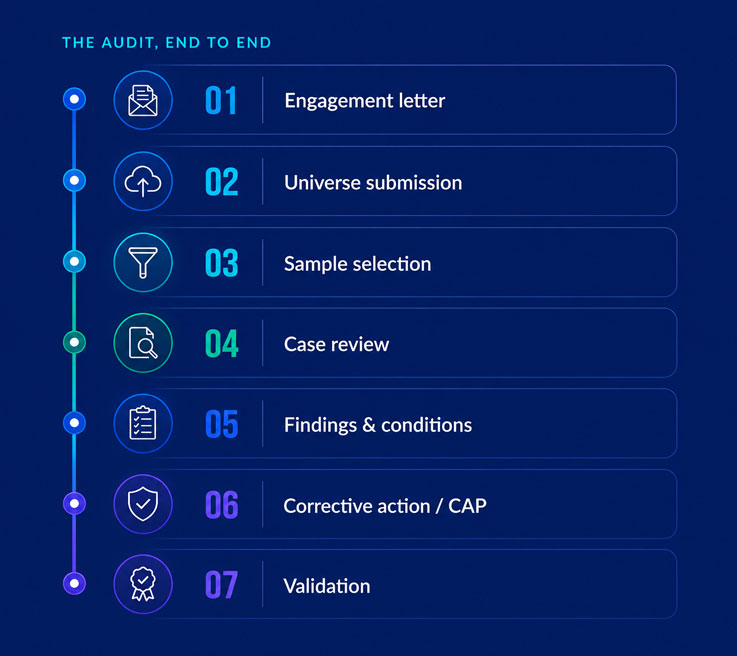
Automate audit planning, execution, and reporting to save time and reduce errors. Ensure consistent compliance and operational transparency across all departments. Step up your audit game with our Internal Audit solution, designed to tackle the toughest challenges in health plan compliance. Elevate your organization’s compliance with new-age tools that turn audit headaches into operational wins.
Comprehensive audit management
Supercharge your audits from start to finish, streamlining every step of the process to enhance efficiency and compliance.
Real-time monitoring and reporting
Get instant, actionable insights with real-time data, enabling swift, informed decision-making that keeps you ahead of the curve.
Automated workflow
Ditch the manual grind with automated tasks and alerts, speeding up the audit process and slashing effort by half.
Integrated audit findings
Consolidate all audit data into one place, making monitoring and analysis of findings and corrective actions effortless.
Product Suite / Audit and Monitoring
Continuous Monitoring
Monitor key performance indicators continuously to gain actionable insights and make data-driven decisions. Enhance operational performance and reduce risks. Harness data for strategic insights and proactive risk management, ensuring high standards in compliance and operational efficiency. Say goodbye to inefficiencies and hello to data-driven excellence.
Seamless integration
Deploy as a standalone tool or integrate with other Inovaare solutions, such as Appeals & Grievances, UMS, Audit, CAP, and Delegation Oversight, for comprehensive tracking.
Customizable dashboards
Create tailored KPI consoles with individual thresholds and tolerance limits, providing stakeholders with actionable insights.
Automated incident logging
Detect and log outliers before they become threats, automating incident response and corrective actions for timely resolution.
Real-time KPI analysis
Continuously monitor and analyze performance metrics to measure the effectiveness of compliance programs and operational improvements.
Product Suite / Audit and Monitoring
Audit Copilot
Automatically identify and log issues, provide real-time alerts, and suggest corrective actions. Streamline audit processes and achieve proactive risk management. Seamlessly navigate compliance with an integrated data platform, NLP query capabilities, and real-time insights. Transform your audit workflow and elevate your organization’s compliance game.
AI-powered search and analysis
Utilize AI to search and analyze vast amounts of audit data quickly and accurately.
NLP query capabilities
Leverage natural language processing to query and extract meaningful information from complex datasets easily.
Advanced data visualization
Go beyond the surface with powerful data visualization tools that provide deep insights at a glance.
Intelligent summarization
Get concise, actionable audit findings and report summaries, enabling faster decision-making.
Product Suite / Universe Management System
Universe Generator
Universe Generator is typically engaged when a health plan does not yet have a standardized universe-generation process in place. When required data elements are dispersed across multiple systems or not organized in CMS template format, our team designs and implements the extraction, mapping, and file-generation logic needed to produce structured universe files aligned with CMS specifications. Once structured universes are established, files can flow into the Universe Management System for validation and ongoing audit support.
Assessment and design
Evaluate existing data sources and identify required CMS universe elements across systems, departments, and delegates.
Data mapping and structuring
Define extraction logic, field mappings, and transformation rules to assemble CMS-aligned universe files from disparate systems.
File generation framework
Build repeatable processes to generate universe files according to CMS layout and submission specifications.
Transition to managed validation
Once generation logic is established, files can be routed into Universe Scrubber and other UMS modules for ongoing validation and monitoring.
Not generating structured universes yet? Let’s assess your readiness.
Product Suite / Universe Management System
Universe Scrubber
In the face of tight deadlines, shifting protocols, and program audit pressure, we automate the entire universe management lifecycle, from data extraction to CMS universe report submission, saving time, reducing errors, and keeping you audit-ready.
Centralized audit control
No more stitching together spreadsheets, delegate emails, and siloed systems. UMS consolidates all CMS universe data into one secure environment, streamlining universe management and audit readiness.
Operational visibility
Track scrubber status, data gaps, and submission timelines across departments and FDRs. Teams get the visibility to resolve issues early, before they escalate into audit risks.
Compliance monitoring
Built-in CMS logic, automated validations, task tracking, and KPI dashboards keep your CMS universe reports audit-ready year-round, not just when the deadline hits, keeping your compliance posture strong year-round.
Low total cost of ownership
Self-service configuration empowers compliance and ops teams to manage templates, workflows, and rules without developer support. With fewer errors, faster CMS program audit prep, and 100% clean submissions, the return on investment is measurable across functions.
Product Suite / Universe Management System
Universe Scrubber
Universe Scrubber provides independent, CMS-aligned validation of your audit universes without altering source data, helping compliance and operations teams identify gaps early and reduce audit exposure. It flags structural errors, inclusion/exclusion issues, timeliness gaps, and template misalignment across ODAG (Part C Organization Determinations, Appeals, and Grievances), CDAG (Part D Coverage Determinations, Appeals, and Grievances), SARAG (Service Authorization Requests, Appeals and Grievances), FA (Formulary and Benefit Administration), CPE (Compliance Program Effectiveness), SNPCC (Special Needs Plans Care Coordination), and MMPCC (Medicare-Medicaid Plan Care Coordination) universes, while ensuring data integrity and audit defensibility. It provides a clear, actionable exception report so your team can close compliance gaps before submission or audit.
Compliance
Continuous validation aligned with the latest CMS protocols. Stay aligned with evolving CMS requirements through regularly updated validation rules.
Empower your delegates
Enable delegated entities to validate their universes against CMS-aligned rules before submission, reducing downstream audit risk.
Automated non-compliance identification
Identify common structural and formatting errors, including data format inconsistencies that account for uptp 40% findings.
Built-in rules
CMS-aligned validation rules for inclusion, exclusion, timeliness, and template conformity. Rules are configurable and updated to reflect current CMS guidance.
Dashboards
Real-time dashboards to monitor error trends, exception categories, and compliance exposure across universes.
Mock audits
Simulate CMS audit validation scenarios to assess readiness before formal submission.
Audit readiness
Improve audit preparedness by identifying and addressing universe gaps before CMS review.
Data availability
Business users can run validations on demand without relying on IT teams for ad hoc data checks.
Validate your next universe before CMS does.
Product Suite / Universe Management System
Universe Curator
Universe Curator standardizes recurring structural and formatting inconsistencies before universe generation. It automatically corrects common issues such as date formats, time formats, and field nomenclature that often cause validation failures and resubmissions. For example, if a date appears as “dd/mm/yy” instead of the CMS-required “yyyy/mm/dd,” Curator reformats it according to defined rules. These corrections occur within a controlled processing layer and do not overwrite source systems. When paired with Universe Scrubber, Curator reduces formatting noise so logical validation focuses on true compliance gaps.
Automates formatting standardization
Automatically corrects common structural inconsistencies in date, time, and numeric fields based on predefined rules.
Integrates with Universe Scrubber
Helps prepare standardized data for rule-based validation, improving the clarity and accuracy of exception reporting.
Configurable correction rules
Allows health plans to define formatting and normalization rules aligned with internal standards and CMS template requirements.
Reduces resubmission risk
Minimizes recurring formatting errors that commonly lead to validation failures and submission delays.
Reduce recurring formatting errors at the source.
Product Suite / Universe Management System
Universe Aggregator
Universe Aggregator consolidates multiple universe files into a unified file structure for review and submission preparation. It enables health plans to combine inputs from different systems, departments, or delegated entities into a single, standardized universe output. This reduces manual file consolidation and supports consistent submission workflows. It is designed to preserve data integrity while supporting structured universe preparation and CMS-aligned validation.
Efficient data consolidation
Combine multiple universe files from different sources into a single structured output based on defined aggregation rules.
Consolidated compliance dashboards
View aggregated universe data through centralized dashboards that provide visibility into completeness, volume trends, and submission status across entities.
Streamlined workflow coordination
Simplify coordination across departments and delegates by centralizing universe inputs within a controlled aggregation process.
Improves consistency across submissions
Apply defined aggregation logic to reduce variability introduced through manual file merging.
Consolidating universes manually? There’s a better way.
Product Suite / Healthcare Data Scrubbers
Audit Copilot
Enhance your compliance strategy with our intelligent assistant. Universe Copilot provides real-time insights, guidance, and support, ensuring your data is always audit-ready. Enhance your compliance strategy with our intelligent assistant. Universe Co-Pilot provides real-time insights, guidance, and support, ensuring your data is always audit-ready.
Real-time insights
Gain immediate access to critical compliance data, helping you make informed decisions and respond swiftly to any issues.
Real-time monitoring
Benefit from real-time monitoring and query handling, reducing the burden on your compliance team and enhancing overall efficiency.
Seamless integration
Experience the seamless integration of UMS and USHER, creating a cohesive and robust compliance framework that addresses all your regulatory needs.
Advanced AI capabilities
Leverage AI-driven analytics for deep insights and advanced analysis, helping you anticipate compliance challenges before they arise.
Product Suite / Healthcare Data Scrubbers
Medicaid Log Scrubber
Take the complexity out of Medicaid data management by automating the scrubbing and validation of Medicaid logs to ensure your data is accurate, consistent, and compliant with state and federal regulations.
Regulatory compliance assurance
Ensures all logs meet state and federal Medicaid requirements, giving you confidence in your data's accuracy and completeness.
Detailed reporting
Generates comprehensive reports that highlight data discrepancies and corrections, providing full transparency and traceability.
Easy integration
Seamlessly integrates with your existing data systems, making the log scrubbing process quick and hassle-free.
Audit-ready logs
Prepares your Medicaid logs for audits by validating them against regulatory standards, ensuring you are always ready for review.
Product Suite / Healthcare Data Scrubbers
Call Log Scrubber
Go beyond the surface of call logs to identifying exactly what each call includes and flagging appeals or issues that need more attention to reduce potential non-compliance.
Automate your call log management
Automate the organization of call logs for seamless member support, reducing manual efforts and ensuring consistent documentation.
NLP-enhanced case scrubbing
Scrubber performs NLP on the description field, ensuring the right cases remain in Customer Service.
Compliance monitoring
Identify hidden issues within call logs to maintain compliance and address concerns promptly, preventing compliance breaches with proactive monitoring.
Automated reporting
Generate comprehensive regulatory call log reports in a single click, saving time and effort, and simplifying reporting with automated tools.
Product Suite / Healthcare Data Scrubbers
Data Scrubber
Simply align your data with the appropriate rules set, and the scrubber takes care of the rest. It ensures your data is not just compliant but also optimized for operational efficiency, enabling more accurate reporting and streamlined workflows across your organization.
Adaptable scrubbing rules
Customize scrubbing rules to fit any type of data set, making it versatile for various operational and compliance needs. All you need is the right rules set, and the scrubber does the rest.
Comprehensive audit trails
Keeps a detailed record of all data corrections and validations, offering full transparency for compliance audits and operational reviews.
Seamless integration with existing systems
Integrates effortlessly into your current systems, enhancing data management without disrupting existing workflows, making it easy to implement across various departments.
Compliance and operational assurance
Aligns your data with regulatory standards while optimizing it for daily operations, minimizing compliance risks and ensuring smooth, error-free processes.
Product Suite / Provider Relationship Management
Provider Dispute Resolution
Efficiently manage and resolve provider disputes to ensure timely resolutions, reduce administrative burdens, and foster transparent and collaborative relationships.
Letter management
Efficiently manage provider correspondence with our letter management module.
One-click report generation
Manage dispute-related costs effectively, ensuring optimal resource allocation.
Real-time dashboards
Leverage advanced reporting tools to reduce processing times, identify patterns, and prevent unnecessary disputes.
Reporting and analytics
Generate detailed reports and analyze trends to improve dispute resolution strategies.
Product Suite / Provider Relationship Management
Potential Quality Improvement
Safeguard the quality of care within your provider network, ensuring that potential issues are addressed swiftly and effectively. By maintaining a high standard of care, you enhance member satisfaction and build a stronger, more reliable network.
Automated issue detection
Monitor provider data and member feedback to detect potential quality issues to ensure that any deviations from expected care standards are identified promptly.
Targeted interventions
Recurring issues and potential risk items are flagged for targeted interventions before they escalate into larger threats to prevent risks and ensure consistent care quality.
Data-driven insights
Leverage analytics and reports to gain insights into quality trends within your network and make informed decisions that enhance provider performance and care outcomes.
Centralized issue management
Track investigations, document findings, and implement corrective actions through a centralized dashboard, ensuring a thorough resolution process.
Product Suite / Provider Relationship Management
Quality Improvement Organization
Streamline the QIO appeals, resulting in a more efficient, compliant, and transparent process that allows you to focus on delivering quality care and improving member experiences. Stay aligned with the QIO Program by using data to track healthcare quality improvements and address beneficiary complaints efficiently.
QIO appeals
Manage provider-based notice appeals and EMTALA violations with precision and transparency, fostering trust and compliance.
Data analytics
Generate comprehensive reports on trends and denial reasons, facilitating data-driven interventions and policy adjustments.
Payment integrity
Ensure that Medicare pays only for necessary services and goods provided in the appropriate setting.
Cost savings
Reduce costs with automated checks and validations, safeguarding the Medicare Trust Fund.
Product Suite / Provider Relationship Management
Provider CRM
Build and maintain strong relationships with your provider network. Centralize provider information, track interactions, and ensure personalized communication to enhance engagement and streamline administrative processes.
Unified provider database
Centralize all provider information for easy access and management.
Comprehensive interaction logs
Track all communications and interactions with providers.
Personalized outreach tools
Customize communication strategies to engage providers effectively.
Integration capabilities
Seamlessly integrate with existing systems for streamlined operations.
Product Suite / Provider Relationship Management
Healthcare Operations Copilot
Leverage advanced AI to strengthen your provider network. By automating routine tasks, providing real-time insights, and facilitating seamless communication, this AI-powered assistant ensures that you focus on building strategic partnerships, improving collaboration, streamlining provider interactions, and ensuring a high-performing network.
Instant AI-driven assistance
Get immediate and accurate responses to your data and compliance queries.
AI-powered outreach
Automate and personalize outreach to providers, enhancing provider engagement without adding to your workload.
AI-enhanced proactive issue resolution
Detect potential issues within the provider network, such as compliance breaches or performance dips, before they escalate.
Real-Time performance monitoring
Identifies trends and flags areas for improvement, enabling you to make data-driven decisions that elevate network quality.
Product Suite / Delegation Oversight
Delegate Determination
Efficiently assess potential delegated entities with criteria-based preliminary evaluations. Ensure only qualified candidates proceed, reducing risk and enhancing compliance. Effortlessly filter and select the best delegates with precision. Delegate Determination ensures that only the most qualified entities make the cut, reducing risk and enhancing compliance from the outset.
Accurate assessments
Quickly assess potential delegates using criteria-based evaluations, ensuring top-tier candidates proceed and minimizing future compliance issues.
Configurable alerts and triggers
Set up alerts and triggers to stay informed about important assessment milestones and outcomes.
Compliance assurance
Maintain high compliance standards by rigorously evaluating delegates against pre-set criteria, giving you peace of mind.
Custom workflows and templates
Create your own assessment workflows and templates to fit your specific needs.
Product Suite / Delegation Oversight
Delegate Repository
Securely store and manage all delegate details post-qualification. Keep comprehensive, up-to-date records accessible, simplifying oversight and audits. Keep all essential delegate information in one secure and easily accessible place to ensure that you stay organized and in control, simplifying oversight and audits.
Centralized storage
Store all delegate details post-qualification in one secure location, making it easy to manage and retrieve information.
Easy access
Have up-to-date records at your fingertips, facilitating efficient oversight and reducing search time.
Data security
Protect delegate information with robust security measures, ensuring data integrity and compliance with privacy regulations.
Enhanced oversight
Improve oversight capabilities by centralizing information, which simplifies audits and reviews, saving valuable time.
Product Suite / Delegation Oversight
Delegate Audit & CAP
Conduct thorough audits of delegated entities to ensure adherence to contractual and regulatory requirements. Maintain high standards of compliance and mitigate risks effectively. Ensure effective oversight, streamline audit processes, and maintain regulatory compliance with ease. Transform your delegation management and safeguard your organization’s integrity with the latest technology solutions.
Centralized oversight
Manage all delegated entities efficiently with centralized audit controls, ensuring comprehensive oversight and compliance.
Effective issue resolution
Automatically log and track issues, facilitating swift resolution and maintaining compliance across all entities.
Real-time compliance monitoring
Continuous data validation ensures that universe files are always accurate and up-to-date, reducing errors and improving compliance.
Automated universe scrubbing
Delegates can easily scrub universe files for accuracy and compliance, ensuring clean and compliant data submissions.
Product Suite / Delegation Oversight
Reporting & Monitoring
Leverage template-based data collection and analysis to monitor KPIs. Identify outliers and potential risks early, enabling proactive management and compliance assurance. Gain real-time insights and stay proactive with comprehensive reporting and monitoring. Keep track of delegate performance and compliance effortlessly with smart data analysis.
Custom collections and templates
Create your own data collections and templates tailored to your specific needs.
Set reporting frequency
Customize the frequency of your reports to match your operational requirements.
Build data validation rules
Build rules easily for data validation to ensure accuracy and reliability.
Set KPI thresholds
Define thresholds for key performance indicators to monitor and maintain desired performance levels.
Advanced visualization
Visualize data effectively to make complex information easily understandable.
Bulk collection
Send bulk data collection requests to streamline data gathering from multiple sources.
Form-based to Excel-based
Flexibly collect data using both form-based and Excel-based methods to suit various needs.
Track collection status
Monitor the status of data collections in real-time to ensure completeness and timeliness.
Product Suite / Universe Management System
Part C & D Reporting Automation
Our Part C & D Reporting module simplifies the complex process of preparing and submitting your annual CMS reports. Designed specifically for Medicare Advantage and Part D plans, the solution ensures accurate data capture, pre-submission validation, and timely delivery of compliant reports to CMS.
Built-in CMS templates
Submit standardized Part C & D reports using preloaded formats mapped to CMS requirements.
Pre-validation and cross-checks
Enforce formatting and data accuracy at the point of entry. Prevent common errors like misused zero entries or invalid percentages.
Quality assurance thresholds
Auto-flags statistical outliers and CMS-defined potential problem zones before submission.
Works for delegate data too
Apply the same rules to delegatesubmitted reports. Keep everything consistent, traceable, and compliant.
Product Suite / Universe Management System
Part C & D Builder & Scrubber
This specialized solution automates the end-to-end lifecycle of Part C & D file preparation—from raw data ingestion to final scrubbed outputs. Whether you're prepping Enrollment/Disenrollment (EGHP), PDEs, or SNP-MOC reports, our generator and scrubber ensure your data files are clean, consistent, and CMS audit-ready.
Automated Pat C & D file generation
Convert complex, multi-source data into structured CMS-ready formats without manual scripting.
Advanced data scrubbing
Apply proprietary validation rules to catch format mismatches, outliers, and logic errors.
File-level integrity assurance
Validate field types, record lengths, code lists, and business logic to reduce risk of rejections.
Modular and scalable
Use as a standalone service or integrate into your broader UMS workflow for end-to-end efficiency.

Solutions / GRC
Governance
Surveys & Assessments
Gather internal feedback, score governance maturity, and identify blind spots across teams or departments.
Strategy & Projects
Track strategic initiatives, flag delays, and tie projects to operational outcomes with built-in governance workflows.
Executive Dashboards
Deliver real-time views of governance KPIs, project performance, and risk exposure — in one place.
Policy Governance
Ensure enterprise-wide access to approved policies with version tracking, role-based updates, and audit logs. It links governance strategy to policy execution and is crucial for compliance alignment.
Delegation Oversight Governance
Delegation is a governance responsibility under CMS that ties governance to contractual and operational risk. Track delegated entity performance against SLAs, trigger governance reviews, and maintain accountability across vendor relationships.
Control Repository
Centralize all operational, regulatory, and compliance controls in one governed repository. Map each control to policies, risks, audits, and corrective actions for full traceability.