
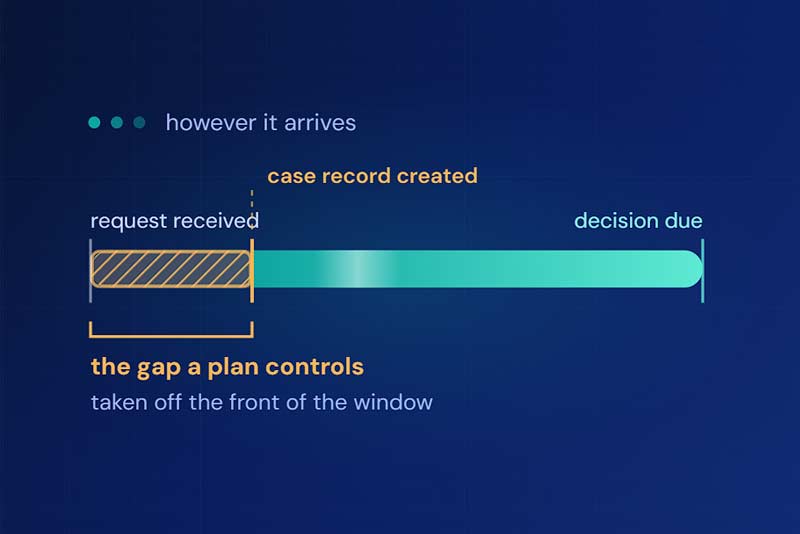
In Medicare Advantage, a standard organization determination is due within 7 calendar days for services subject to prior authorization and 14 for services that are not, while a request for a Part B drug is due in 72 hours. As a rule, the clock starts when the request arrives, and it never waits for the case record.
The Clock
Why intake is where timeliness is won or lost
Nothing about a phone call or a fax announces which clock it started. A standard request can land on any of three clocks: 7 calendar days for a service or item subject to prior authorization, 14 calendar days for a service or item outside those rules, and 72 hours for a Part B drug, which cannot be extended (42 CFR § 422.568(b)(1)(i)–(ii), (b)(3)). The 7-day track applies beginning on or after January 1, 2026, to services subject to the § 422.122 prior authorization rules. Three clocks, one set of doors, and whoever picks up the contact makes the choice among them.
As a rule, all three run from the date the plan receives the request, and none of them waits for a case record to appear in the system of record. On the 7-day track, a two-day gap between those two events is more than a quarter of the base window, before any permitted extension (§ 422.568(b)(2)(i)). A 14-day window can absorb two days. A 7-day window has far less room for them, and on a 72-hour clock they are most of the window.
As a rule, each clock runs from receipt of the request or grievance (for an expedited request, receipt by the appropriate department, per CMS guidance § 10.5.2), so any delay between arrival and case creation is taken off the front of the window. The bars show the base timeframes before any permitted extension (42 CFR §§ 422.564(e)(2), 422.568(b)(2)(i), 422.572(b)(1)). The two-day lag block is illustrative rather than a measured figure. Not shown: a request for a Part B drug runs on its own 72-hour clock, 24 hours if expedited, and neither may be extended (§§ 422.568(b)(3), 422.572(a)(2)). Sources: 42 CFR §§ 422.564(e)(1), 422.568(b)(1), 422.572(a)(1).
The 30-day grievance clock is anchored the same way: it runs from the date the organization receives an oral or written grievance (42 CFR § 422.564(d)(1), (e)(1)). CMS is specific about whose receipt counts. Under CMS’s Parts C & D Enrollee Grievances, Organization/Coverage Determinations, and Appeals Guidance (effective July 6, 2026), § 10.5.2, the processing timeframe on a standard request begins when the plan, any unit in the plan, or a delegated entity receives it, including a delegated entity that is not responsible for processing. On an expedited request it begins when the appropriate department receives it. That difference matters at intake, because a misrouted standard request and a misrouted expedited request have different clock consequences. The same section requires plans to be able to accept grievance, coverage and appeal requests 24 hours a day, 7 days a week, holidays included. One channel is anchored outside the plan altogether: a CTM complaint starts on the date CMS assigns it, and that channel is covered below.
The first few minutes have to establish more than which clock applies. A request for payment is a separate branch: it must be made in writing unless the plan has adopted a voluntary policy of accepting verbal payment requests (§ 422.568(a)(2)), and it is processed under the prompt payment provisions at § 422.520 rather than against the 7- or 14-day determination timeframe (§ 422.568(c)). Pre-service and post-service requests come through the same doors and read alike in a call summary, but they run on different rules.
Six Channels
What breaks in each intake channel
This section works through six distinct entry points into A&G intake. Each can lose something different between the moment of contact and the moment a case record is created.
Each channel can lose different information on the way in. The intake gate is where those differences have to be reconciled, because everything downstream reads one record.
Member portal and web forms. This looks like the safest channel because it’s structured, but the structure can be incomplete. Free-text complaint fields don’t map cleanly to a CMS grievance or organization-determination category, and a member can end up filing what is functionally an appeal through a general grievance form because that’s the form in front of them.
Phone and the call center. A grievance can be filed orally (42 CFR § 422.564(d)(1)), and the 30-day resolution clock runs from the date the organization receives that oral grievance (§ 422.564(e)(1)), not from the date a representative writes it up. A late log is one exposure on this channel, and the easiest to see. Two others are harder to spot. A call can be logged with an incomplete or inaccurate account of what the member said, because what gets recorded is the representative’s summary and interpretation of the conversation, and the category and expedited decisions downstream are made from that summary. And a contact may never become a case at all: raised on the call, resolved on the call, recorded as an inquiry, never counted. CMS guidance does recognize an inquiry, defined as a request for information that does not express dissatisfaction, such as a routine question about a benefit (§ 10.1). What it does not recognize is an inquiry that expressed dissatisfaction and got fixed. A grievance is “any complaint or dispute, other than one that constitutes an organization determination, expressing dissatisfaction with any aspect of an MA organization’s or provider’s operations, activities, or behavior, regardless of whether remedial action is requested” (§ 422.561), and the same CMS guidance is explicit that where a verbal grievance can be resolved during the same call, the plan must document the resolution and still log and report the call as a grievance (§ 30.2). So the line is not between resolved and unresolved. It is between dissatisfaction and a question. Where a plan draws it, and whether representatives draw it the same way, decides how much of its grievance volume is visible in the first place. A call resolved off the record is also a call that produced no expedited flag.
Mail and fax. The date the item arrived and the date it’s keyed into the system are not always the same day, and batch scanning workflows can stretch that gap further. The keying date is not the receipt date, and the guidance names the anchor channel by channel: for regular mail, the date the plan initially stamps the document received; for a delivery service that tracks delivery, the date the document is delivered; for a fax, the date and time of successful transmission as shown on the fax transmission report (§ 10.5.2). So where the stamp and the system entry date disagree on a mailed item, the stamp governs. The harder version of the problem is inbound that never reaches A&G at all: a grievance addressed to claims or to a general post office box, waiting in a queue owned by a department that has no timeliness clock of its own. Under the receipt rule above, a mailroom outside the A&G org chart is still inside the A&G clock.
Email and shared inboxes. A message landing in a shared inbox can arrive with no case ID and no routing rule, and one email can raise several distinct issues. CMS guidance says each issue should be processed separately under the appropriate procedure (§ 30.1), which in practice means a separate case record for each rather than one combined thread.
CTM complaints. These arrive already classified by CMS, and plan-side review can disagree with that classification. The clock starts on CMS’s assignment date, not when the plan retrieves the complaint (42 CFR § 422.125(a)): 2 calendar days for immediate need complaints, 7 for urgent, 30 for all other complaints (§ 422.125(b)(1)–(3)). A complaint in the 30-day group that is also a grievance can be extended when the grievance extension criteria are met, unless it requires expedited handling, and where a complaint is also a grievance the shortest applicable timeframe governs (§ 422.125(b)(4)–(5)). Separately, the plan must attempt to contact the person who filed the complaint within 7 calendar days of the assignment date (§ 422.125(c)). All of these are calendar days. At a plan that staffs the CTM queue on business days, an immediate-need complaint assigned late on the Friday of a holiday weekend is due by Sunday, before anyone is rostered to look at it. Weekend and holiday coverage for the CTM queue is therefore a timeliness control, not just a staffing preference. What CMS sees in your CTM data covers what that means for plan-side handling.
Delegated entities. Cases arriving through a delegate’s system carry the delegate’s own date conventions. A delegate that stamps “received” on the day it forwards a case, rather than the day it actually received one, creates a timeliness problem for the plan. On a standard request the clock has already started when the delegate receives it, whether or not that delegate is the entity responsible for processing (§ 10.5.2), so a forwarding date has no bearing on the deadline. The MA organization maintains ultimate responsibility for compliance with its CMS contract regardless of any delegation arrangement (42 CFR § 422.504(i)(1)). The 5-stage delegation oversight framework covers the oversight structure behind that.
One axis cuts across all six, and it is easy to miss: whether the request is for a drug or a service, which is a different line from Part C and Part D. Drug coverage requests run in hours with no extension. Service requests run in days, with an extension available. Inside Part C, a request for a Part B drug is due within 72 hours, or 24 if expedited, and neither period may be extended (42 CFR §§ 422.568(b)(3), 422.572(a)(2)). Service and item requests arriving through the same doors run on 7 or 14 calendar days, with up to 14 more available (§ 422.568(b)(1), (b)(2)(i)). A plan with a Part D benefit takes drug coverage determinations through those doors on the same short clocks: 72 hours standard, 24 hours expedited, and 14 calendar days for a Part D payment request (§§ 423.568(b), 423.572(a), 423.568(c)). On a Part D exceptions request, the 72 hours run from receipt of the prescriber’s supporting statement rather than from the request itself (§ 423.568(b)), so the clock-start field and the contact date are not always the same date. How a request arrives doesn’t tell intake which clock it’s on. What’s being requested decides most of that, and it has to be settled at first contact, before the case is written up.
The Record
What every case record needs at the point of entry
The six channels above can lose different things, but the fix is the same: a consistent capture standard applied at first contact, regardless of which door the case walked through.
| Channel | What typically gets lost | What intake has to capture |
|---|---|---|
| Member portal / web forms | The correct CMS category, since free text doesn’t map to one | Category, with the reason for that categorization recorded |
| Phone / call center | The true receipt date and time of an oral grievance, and an accurate account of what the member said | A receipt timestamp independent of when the call gets logged, and a call ID linking the record to the recording where one exists |
| Mail / fax | The gap between the physical date stamp and the system entry date, and inbound misrouted to another department | The plan’s own received-stamp date, or the fax transmission time, as the clock start, with the system entry date recorded alongside it |
| Email / shared inbox | A case ID, and the fact that one email may hold several issues | Separate case records for each distinct issue |
| CTM | Whether the plan agrees with CMS’s assigned category | CMS’s assignment date and category as received, flagged for review |
| Delegated entities | The delegate’s actual receipt date | The delegate’s original receipt date, not its forwarding date |
| Field | What it has to carry |
|---|---|
| Receipt date | The date the plan received it, not the date it was keyed.Case timeliness is calculated from this date, unless a rule moves the start later, as missing representative documentation does. |
| Channel | Which door it arrived through, recorded as a value rather than inferred later. |
| Who received it | The person or system at the plan that took it in. |
| Requestor type | Member or representative, and for a representative, whether the appointment is documented. |
| Category | The assigned case type, with the reason for it recorded alongside. |
| Physician support | Whether a physician supported the member’s request, and when that support was received.If the physician indicates the standard timeframe could seriously jeopardize the member’s life, health or ability to regain maximum function, the plan must expedite. |
| Expedited flag | Decided at intake, with the time it was set recorded if it changes later. |
| Reclassification trail | Any later change to the category, with who changed it and why. |
Underneath the channel-specific gaps, every case record needs the same core fields: receipt date, channel, who at the plan received it, requestor type, whether a physician supported the request, category with the reason recorded, an expedited flag, and an audit trail showing who changed a classification later and why.
Requestor type earns its own field because of the representative question. A representative is “an individual appointed by an enrollee or other party, or authorized under State or other applicable law, to act on behalf of an enrollee or other party involved in the grievance or appeal” (§ 422.561). Those are two different things to establish, and intake has to record which one applies and whether the appointment is documented. The reason it belongs at intake rather than downstream is that the clock position turns on it. When someone claiming to be a representative has not supplied valid documentation, the guidance starts the processing timeframe on the date the plan receives the documentation, requires the plan to notify the enrollee and the purported representative in writing that the request is not valid until then, and requires the plan to document its reasonable efforts to obtain it (§ 20.2.1). The plan may begin its review while it waits for the documentation, but it may not issue a decision until the documentation is received. If it never arrives, the plan dismisses the request because the person making it was not permitted to request an organization determination (42 CFR § 422.568(g)(1)), with written notice of the reason, the right to ask the plan to vacate the dismissal and the right to request reconsideration of it (§ 422.568(h)). Expedited requests are the exception the script has to carry, because the same guidance directs plans to make sure they are not delayed while documentation is chased. If intake does not record, on the day the request arrives, whether an appointment was produced, the plan has no contemporaneous evidence of when its clock started, why it dismissed the request, or that it handled the request correctly.
Getting these fields right at intake pays off past the individual case: the same receipt dates, categories, and requestor data captured here later get pulled into audit universes, so an error at intake doesn’t stay contained to one case. Scrubbing ODAG and CDAG universes before submission covers what happens when it isn’t caught first.
The Fork
The classification decisions made in the first few minutes
Three decisions happen at intake, often within the first few minutes of a contact, and none is easy to correct later without leaving a trace.
Each issue in a contact runs through the fork separately (CMS guidance § 30.1).
Whoever first picks up the contact decides which way it goes. A grievance is defined residually: dissatisfaction with the plan or a provider that is not an organization determination (42 CFR § 422.561). An organization determination covers things like a refusal to provide or pay for services, or a failure to approve, furnish or pay for services in a timely manner where the delay would adversely affect the enrollee’s health (§ 422.566(b)). So intake has to ask first whether the contact asks for, or disputes, a coverage decision. The member’s own words don’t settle it. CMS guidance gives the example of a caller who says they want to file a grievance because a drug or service was denied, and says that where an adverse determination has been made, the dispute should be treated as an appeal of the denial (§ 30.1). For each issue in the contact, grievance comes into it only once a coverage decision is ruled out, and then only if the issue expresses dissatisfaction. A plain request for information is an inquiry.
Expedited status has to be decided promptly, and the first decision is usually made at intake. When a member or their representative asks for an expedited decision, the plan must expedite it if it determines that applying the standard timeframe could seriously jeopardize the member’s life or health, or ability to regain maximum function (42 CFR § 422.570(c)(2)(i)). Where a physician supports the member’s request, the test changes: the plan must expedite if the physician indicates that applying the standard timeframe could cause that harm, with no separate determination by the plan (§ 422.570(c)(2)(ii)). That support can be oral or written (§ 422.570(b)(2)), and it can arrive after the request itself (CMS guidance § 40.8), so intake has to record whether a physician supported the request, and when. On an expedited organization determination the plan has 72 hours from receiving the request for a service or item (§ 422.572(a)(1)), and 24 hours on a request for a Part B drug, which cannot be extended (§ 422.572(a)(2)). A request that qualified on arrival but was not recognized can use up most of that window before anyone knows it was short. And a single contact raising several distinct issues needs several case records, even though it is easy to log it as one.
Where that fork goes wrong, and what the pattern looks like in CMS audit data, is covered in a separate piece on grievance misclassification and how it starts at intake.
The Boundary
What to automate and what needs human judgment
Not every part of intake calls for the same kind of attention. Treating all of it as equally automatable, or all of it as equally requiring judgment, misses where the actual risk sits.
Automate
Deterministic, repeatable, and better done the same way every time
- Channel capture and date stamping
- Queue assignment
- Routing rules
- Timeliness tracking against the clock
Needs human judgment
Judgment calls that carry regulatory consequence
- Category assignment on ambiguous contacts
- Clinical urgency
- Approval of any reclassification
The split follows which decisions a reviewer will later ask a person to account for.
Channel capture and date stamping, queue assignment, routing rules, and tracking a case against its applicable clock are mechanical, repeatable steps that benefit from being handled the same way every time, with a system of record showing when each step happened. Automating them doesn’t remove judgment from intake. It removes inconsistency from parts of intake that were never supposed to need judgment in the first place.
Category assignment on an ambiguous contact, clinical urgency, and approval of any later reclassification call for a person; automation there should assist that judgment, not replace it. On the phone channel specifically, call-recording and transcript review can flag details a representative’s written summary might miss: a member describing symptoms or how urgent the need is. It can then route that call to someone with the authority to make the classification decision. The representative and reviewer still decide. The transcript just makes sure that decision is checked against the whole conversation, not a note taken from it.
Find where your intake lag sits
A 30-minute walkthrough shows how all six intake channels can be captured to one standard, alongside your existing systems.
Request a DemoMeasurement
How to measure whether intake is working
Three measures give an operations leader a working read on intake. Each is a definition a plan computes from its own case data rather than a figure to compare against an industry number. Where the underlying timestamp isn’t being captured yet, that absence is the first thing the measure tells you.
Receipt-to-case-creation lag, by channel
Break it out by channel, and look for the one carrying most of it.
Share of cases reclassified after intake
Read it against how far into the case the change happened, not on its own.
Share of expedited cases flagged at intake
The second row is where the 72-hour cases get lost.
All three are computed from a plan’s own records. Track the direction of travel rather than comparing against an outside figure.
Lag between receipt and case creation, by channel. The gap between when a complaint or request actually arrived and when it became a trackable case record, broken out separately for phone, mail, email, portal, CTM, and delegated intake. A single blended average across all channels tends to hide the one channel where the lag is actually concentrated. Expect the two highest-risk channels to be the two that cannot report it yet. For phone contacts, the receipt timestamp lives in the telephony platform rather than the case system, so the measure depends on joining those two records by call ID. For mail, the received-stamp date often exists only on the scanned image, not as a keyed field. Where that is the case, capturing the stamp date as a keyed field is the first job, and the measure comes after.
Share of cases reclassified after intake. How often a case’s grievance/appeal or standard/expedited classification changes after the initial intake decision. This one does not mean anything on its own, and it is worth saying so when you present it: a rising share can mean intake decisions got worse, or it can mean quality review started catching what it had been missing. Pair it with how far into the case the change happened. A reclassification on day one and a reclassification on day twelve describe different problems, and only the second has already cost the clock. It also depends on the case system versioning the classification field rather than overwriting it, so for some plans the honest first answer is a date to start counting from.
Share of expedited cases flagged at intake versus discovered later. Of all cases eventually handled on an expedited basis, how many were flagged as expedited at first contact versus identified only afterward. The second group represents time already spent before anyone knew the clock was a short one. One caveat on the denominator: it holds cases eventually handled on an expedited basis. A case whose urgency nobody ever recognized is in neither group.
All three share a boundary worth stating before any of them goes into an operations review: each can only see cases that were created. A contact that never became a case record has no lag, no reclassification and no expedited flag, and is missing from the numerator and the denominator alike. So the three numbers need one check standing next to them that does not depend on the case system at all: a periodic call sample, listened to against the cases actually logged from those calls. It is the one check that does not inherit the blind spot.
Sources: 42 CFR §§ 422.122, 422.125, 422.504(i), 422.520, 422.561, 422.564, 422.566, 422.568, 422.570, 422.572, 422.578, 423.568 and 423.572, together with CMS’s Parts C & D Enrollee Grievances, Organization/Coverage Determinations, and Appeals Guidance (effective July 6, 2026), §§ 10.1, 10.5.2, 20.2.1, 30.1, 30.2 and 40.8. Regulatory timeframes and requestor categories cited above are drawn from the current text of those sections. The day-count requirements shown for Complaints Tracking Module cases are those set out at § 422.125(b).