
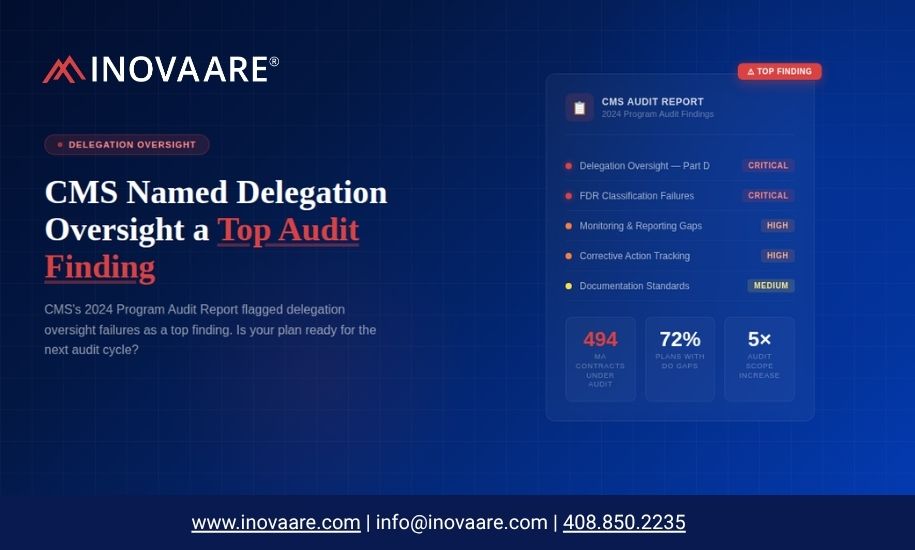
CMS’s 2024 Program Audit Report explicitly flagged FDR oversight failures as a recurring deficiency across Medicare Advantage plans. With CMS now planning to aduit all MAPD contracts annually, the window to fix your delegation program is closing fast.
If your compliance team doesn’t have a systematic, documented process for overseeing your delegated entities — your PBM, your utilization management vendor, your provider network, your customer service contractor — CMS’s 2024 Program Audit and Enforcement Report is directed squarely at you.
The report, released July 15, 2025, covered 494 contracts representing 87.6% of the total Medicare Part C population. Among its most pointed findings: sponsors repeatedly failed to track, address, and correct compliance issues related to functions performed on the plan’s behalf by delegated entities. CMS issued an explicit “Sponsor Tip” — its clearest signal short of a sanction: implement routine monitoring to oversee delegated entities and ensure CMS regulations are being followed.
“Internal routine monitoring processes didn’t detect untimely notifications to enrollees when a delegated entity misinterpreted regulatory requirements. Sponsors should implement routine monitoring to oversee their delegated entities in order to ensure CMS regulations are being followed.”
That isn’t generic guidance. It is a documented finding — the kind that, left unresolved, leads to corrective action plans, civil money penalties, and public enforcement actions. And with CMS dramatically expanding its audit volume in 2025 and 2026, plans that have historically avoided intense scrutiny are now firmly in scope.
The Audit Landscape Has Changed Permanently
For most of the last decade, CMS audited roughly 60 Medicare Advantage contracts per year — a fraction of the total plan universe. That meant most plans had a reasonable chance of going years between formal program audits. That era is over.
In 2025, CMS announced it will audit all eligible MA contracts annually — approximately 550 plans — while simultaneously accelerating completion of a backlog of audits covering payment years 2018 through 2024. CMS is scaling its medical coder workforce from 40 to approximately 2,000 reviewers by mid-2025 and deploying advanced technology systems to flag unsupported diagnoses and incomplete documentation at a pace previously impossible.
For compliance leaders, this is not an incremental change in audit intensity. It is a structural shift in the regulatory environment. The question is no longer whether your plan will be audited. It is whether your documentation will hold up when the audit team arrives.
Why Delegation Oversight Is the Hardest Finding to Defend
Health plans are legally responsible for every CMS-regulated function they delegate. That accountability doesn’t transfer to the vendor — it stays with the plan. So when a delegated entity misinterprets a coverage requirement, delays a notification, or processes a universe submission incorrectly, the finding lands on the plan sponsor. Not the vendor.
What makes delegation-related findings particularly damaging in a CMS audit context is the documentation requirement. In our view, it is not enough to show that a problem was eventually corrected. Based on the pattern of audit findings we’ve analyzed, we believe CMS is looking for evidence of a systematic, documented process that demonstrates the plan was actively overseeing delegated functions throughout the year, not just reacting to complaints or audit notifications.
If your delegation oversight process lives in spreadsheets, email, and annual review meetings, you will struggle to reconstruct a credible audit trail. CMS looks for timestamped actions, continuous monitoring evidence, and a documented escalation path from SLA breach to corrective action. Retrospective documentation is not a substitute for contemporaneous records.
Most health plans conduct annual FDR/DE audits. But in our reading of CMS’s 2024 findings, annual audits alone are not sufficient. We believe the agency’s direction points toward continuous monitoring: real-time visibility into SLA performance, timely escalation of deficiencies, and a documented corrective action path for every breach identified between annual audits.
Five Chronic Oversight Failures
Based on the 2024 Program Audit Report and the pattern of delegation-related findings across prior years, five specific failures appear repeatedly across plans of all sizes:
| # | Oversight Failure | What We Believe CMS Expects |
|---|---|---|
| 1 | No documented pre-delegation qualification process. Sponsors cannot demonstrate they systematically evaluated a vendor’s compliance capability before delegating a CMS-regulated function. | In our view, plans should have a documented pre-delegation assessment with qualification criteria, vendor responses, and approval decisions on file. |
| 2 | SLA monitoring is reactive, not continuous. Plans discover SLA breaches only during annual audits or after member complaints — not through real-time monitoring systems. | In our assessment, plans should demonstrate routine monitoring throughout the year with documented SLA thresholds, breach alerts, and escalation timelines. |
| 3 | Compliance issues identified but not tracked to resolution. Deficiencies are noted in annual audit reports but there is no documented corrective action process with deadlines, ownership, and closure evidence. | We believe every identified deficiency should be linked to a structured CAP with assigned owners, due dates, and evidence of effective closure. |
| 4 | No centralized repository for delegation documentation. Contracts, delegation agreements, compliance attestations, and audit history are scattered across systems and departments. | Based on our experience, plans should maintain a single, auditable repository for all delegation documentation accessible to compliance reviewers on demand. |
| 5 | Delegated entities are not integrated into universe data quality processes. FDR-submitted data is not validated at the entity level before it flows into plan-level universe files submitted to CMS. | In our interpretation, plans should implement entity-level data validation with error attribution, remediation at the source, and a documented submission history for every FDR. |
What “Effective Oversight” Looks Like to CMS
CMS’s compliance program effectiveness (CPE) audit domain is where delegation oversight is formally evaluated. When CMS auditors assess CPE, we believe they are looking for evidence that the plan has operationalized, not just documented, its oversight responsibilities. Based on our analysis of audit findings and CMS guidance, that means they likely want to see:
- A documented pre-delegation assessment process for each category of delegated function, with completed assessments on file for every active FDR/DE
- Executed delegation agreements with specific performance standards, SLA commitments, and CMS compliance obligations spelled out
- A monitoring program with defined metrics, tolerance thresholds, and a documented process for what happens when a threshold is breached
- Evidence of corrective action — not just identification of problems, but structured CAPs with timelines, evidence of remediation, and validation that the fix was effective
- A complete audit history for each entity, including prior findings, CAPs issued, and closure documentation
Plans that manage this process in spreadsheets and email rarely have a complete, timestamped record of all these touchpoints. When an auditor asks for documentation of how a specific SLA breach was identified, escalated, and resolved in Q3 of last year, in our experience, the answer “we track that in Excel” will not hold up.
In our view, CMS auditors do not just want to know that oversight occurred. They want a system-generated, timestamped record that makes it impossible to claim oversight didn’t occur. We believe the difference between passing and failing a CPE audit on delegation is almost always a documentation question, not an operational one. Most plans are doing more oversight than they can prove. The goal is to make oversight provable by default.
The Action Plan for Compliance Leaders Right Now
Given the expansion of CMS audit scope and the explicit delegation oversight findings in the 2024 report, here is our immediate priority list for health plan compliance officers and delegation oversight leads:
1. Inventory your FDR/DE population and documentation gaps
Start by mapping every entity to which you currently delegate a CMS-regulated function. For each entity, confirm that a signed delegation agreement, completed pre-delegation assessment, and current monitoring collection exist and are accessible in a single location. Document every gap.
2. Audit your monitoring collections for continuity
Review your SLA monitoring data for the past 12 months. Can you demonstrate continuous monitoring, not just quarterly review? Is there a timestamped record of every SLA breach, how it was flagged, and when corrective action was initiated? If the answer is no, we believe your monitoring program likely falls short of what CMS expects.
3. Map every open finding to a structured CAP
Any deficiency identified in a prior FDR/DE audit should have a corresponding CAP with an assigned owner, specific remediation steps, and a documented closure date with evidence of effectiveness. If your CAP tracking is separate from your delegation oversight documentation, the audit trail is incomplete.
4. Establish a DE Portal for document collection
In our experience, email-based document collection from delegated entities is not a repeatable, auditable process. A structured portal that tracks document submission, generates timestamped receipts, and flags overdue submissions replaces the annual email fire drill with a defensible process.
5. Evaluate whether your current tools can produce an audit-ready report in 48 hours
When CMS issues an engagement letter, you typically have days — not weeks — to begin producing documentation. If your compliance team would need days just to gather the baseline materials, let alone organize them into an audit-ready package, that is a critical operational gap to close before your next audit notification arrives.
See How Inovaare Structures the Complete Delegation Lifecycle
From pre-delegation assessment through FDR audit and CAP closure, Inovaare’s Delegation Oversight platform manages every stage of the process your CMS auditor expects to see — with timestamped evidence, continuous monitoring, and a secure DE Portal built in.
Explore the Platform Request a DemoThe Bottom Line
In our assessment, CMS’s 2024 Program Audit Report is the clearest signal the agency has sent in years about delegation oversight expectations. The combination of explicit audit findings, the expansion to annual audits for all 550 MA contracts, and the explicit “Sponsor Tip” about routine monitoring makes the direction, as we read it, unmistakable: plans that cannot demonstrate systematic, continuous oversight of their FDR/DE network are taking on material compliance risk.
The good news is that the process we believe CMS expects is well-defined. Pre-delegation determination, a centralized repository, continuous SLA monitoring, structured FDR audits, and documented CAP closure. Plans that build those five stages into a single documented system, rather than managing them across disconnected spreadsheets and email, will be positioned to walk into any audit with confidence.
The plans that will struggle are the ones that believe oversight is happening because conversations are happening. Based on everything we’ve seen, CMS wants the receipts.
Sources: CMS 2024 Part C and Part D Program Audit and Enforcement Report (July 2025); CMS Press Release on RADV Audit Expansion (2025); CMS Program Audits page, cms.gov.