
A Morning That Looked Routinee
How a routine provider dispute becomes an SLA crisis
A provider’s billing coordinator calls your contact center on a Monday morning. She’s disputing what she describes as a payment shortfall on a recent claim. The contact center agent listens carefully, asks the right questions and logs the case. She’s experienced. She’s doing everything right.
But the billing coordinator used the word “payment” several times and never once mentioned “authorization.” What the agent couldn’t see, and had no quick way to check while managing a live call, was that the underlying denial wasn’t a payment calculation error. It was triggered by a missing prior authorization. The case should have gone to clinical review under a 30-day SLA. Instead, it was logged as a claim dispute and routed to the payment team under a 45-day window.
Nothing visible went wrong on Monday. The error was silent.
By day 11, the payment team realizes the case doesn’t belong with them. A supervisor closes it, re-creates it from scratch and reroutes it. By this point the provider has already received an acknowledgment letter referencing the wrong dispute type — addressing an issue they never raised, while their actual dispute has gone unanswered for nearly two weeks.
The case history now shows it was created twice, with a gap in between that invites questions. The compliance clock has been running on the wrong timeline since day one. The provider calls again, this time frustrated. And somewhere in a dashboard, an SLA that should have been manageable is now at risk.
Nobody made a mistake on purpose. The system worked exactly as it was designed to work. That is the problem.
The Real Culprit: Intake Without the Full PictureWhy manual provider dispute intake fails
Provider disputes arrive through contact center calls, provider portals, emails, written correspondence and, increasingly, directly from the systems providers use to manage patient care. Each channel tells a different part of the story, at a different level of detail.
The intake challenge isn’t volume. It’s context. A correct intake decision requires understanding not just what the provider submitted, but what it means when placed against the claim record, the authorization history, the member’s coverage, the provider’s contract and the regulatory timeline that governs this specific case. That information lives in four or five separate systems, all of which need to come together before a confident classification decision can be made.
When one person is making that call alone, in the moment, the full picture rarely comes together. The consequences are familiar to anyone who has managed this workflow:
- The case reaches the wrong team, who spend days on it before realizing it was never theirs to handle. The compliance clock doesn’t pause for rerouting.
- The reviewer who picks it up cannot begin work because the information needed to evaluate the provider dispute was never captured when the case was created.
- The resolution team invests time working a record only to discover it was linked to the wrong claim or member entirely.
- A time-sensitive case sits in the wrong queue while a tighter regulatory deadline counts down unnoticed.
Any one of these is recoverable. But across hundreds of provider disputes a month, they add up to a drag that never shows up as a single incident. It shows up as a pattern: cases that needed fixing before real work could begin.
Ask any provider disputes operations lead where their team’s time actually goes, and intake rework comes up fast. Cases rerouted, records rebuilt, acknowledgment letters corrected. None of it moves a dispute toward resolution. It just clears the path so real work can start.
How AI intake automation resolves provider disputes correctly
Now run the same scenario through a different model.
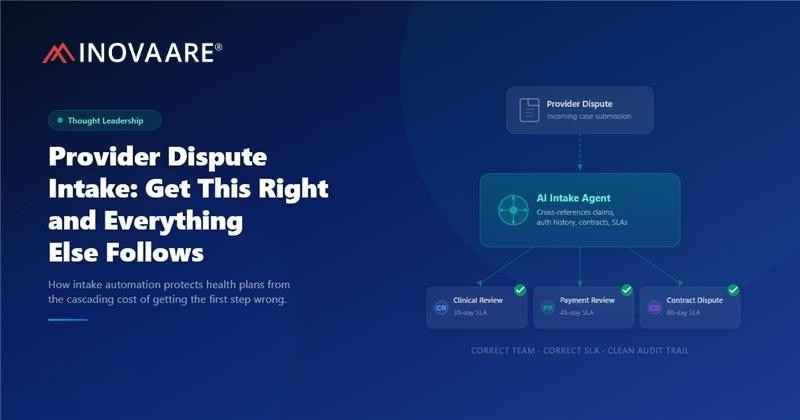
The billing coordinator’s call comes in. The contact center agent takes it. But this time, the moment the case is logged, an intake automation agent works in the background, doing what no single person on a live call could reasonably be expected to do alone.
It reads the call transcript and finds the denial reference. It looks up the claim and sees the reason for the denial: prior authorization was never obtained. Then it checks the authorization record, reviews the provider’s contract and confirms which response timeline applies for the member’s coverage.
In under a minute, it has the complete picture. The billing coordinator described a payment problem. The records show an authorization gap. Those are not the same thing. The difference determines which team handles the provider dispute, which CMS timeliness requirement governs it, what correspondence goes out and what the plan is accountable for.
The case is created correctly from the start. The right compliance clock starts at the right moment. The clinical review team receives it with everything they need already attached. The audit trail is clean from first contact.
No rerouting. No re-creation. The provider who calls back gets a substantive response rather than an apology. When a regulator later asks how this case was handled, the answer is already in the record. The system was trained on the regulatory requirements that govern these decisions, and it applied them.
See How Intelligent Intake Works in Practice
Walk through a live provider dispute scenario with our team. 30 minutes, no commitment.
Request a DemoFrom rules-based automation to intelligent dispute classification
This distinction matters, and older automation tools were not designed to handle it.
Earlier-generation tools were built for consistency, not judgment. They work well when every submission arrives in a predictable format. In health plan operations, that is rarely the case. A billing coordinator describes the problem as she understands it, which is not always what the records show. An authorization issue described in payment language. A contract dispute bundled into a claim query. The surface of the submission and the substance of the provider dispute are frequently different things.
An intake automation agent trained on healthcare regulations and health plan operational patterns is built for exactly this gap. It reconciles what the provider described with what the records actually show — and the classification it produces is grounded in that complete picture, not just the surface of the submission.
The agent does the groundwork. A person makes the call — on every case. When the picture is ambiguous, the agent surfaces it with the analysis already laid out so the reviewer can focus on the decision, not the data gathering. Every recommendation is visible, reviewable and overridable. The system is designed for accountability, not autonomy.
What Gets Better When Intake Gets RightOperational impact of getting provider dispute intake right
The downstream effects are wider than most teams expect before they see the change.
Reviewers spend their time on actual case work instead of chasing missing information or returning incomplete records. Supervisors stop rebuilding cases that should never have needed rebuilding. SLA performance improves, not because the team is working harder, but because fewer cases enter the system already carrying a problem that has to be fixed before anything useful can happen.
For providers, the difference is noticeable. A dispute acknowledged accurately, engaged with on the merits and resolved in a way that addresses what they actually raised. That is what a competent partner looks like. In a market where provider relationships are under strain, that kind of operational reliability gets remembered.
For the compliance team, the record is just there. Complete and traceable. Every case handled according to the rules that governed it. Nothing reconstructed before a review, nothing explained away, because there is nothing that needs explaining.
Fix the Start. Everything Else Follows.Why intake is the highest-leverage fix in provider dispute operations
How well cases get resolved, how clean the compliance record is, how providers experience the relationship, how SLA metrics look on the leadership dashboard. All of it flows from that first case creation moment.
Get that moment right, consistently, and you stop managing the consequences of intake errors. Your experienced people spend their time on decisions that genuinely need them. Your compliance posture is built into the process, not bolted on before an audit. Your providers see a plan that handles their disputes professionally.
Intelligent automation can do this at intake and across other operational and compliance areas where health plans carry regulatory accountability. Your people stay in the process. They just stop spending their time on work the system should be handling for them.
Inovaare has spent decades building compliance and operational management solutions for U.S. health plans — with regulatory requirements built into the foundation, not layered on after. AI Studio is where that experience meets automation: health plans deploy agents across operational and compliance workflows, with regulatory rules, timeliness requirements and accountability structures already in place from day one.
Frequently Asked Questions
Provider disputes get misrouted because intake staff must classify cases in real time without access to the full claim history, authorization status, contract terms and regulatory timelines. A provider may describe an authorization denial as a payment issue, and the intake agent has no quick way to verify the underlying cause during a live call. The case gets logged under the wrong type, sent to the wrong team and governed by the wrong SLA.
AI intake automation reads the provider’s submission, cross-references it against the claim record, authorization history, contract terms and applicable CMS timeliness requirements, then classifies the case accurately before routing it. This eliminates the gap between what the provider described and what the records show, ensuring the right team receives the case with the right SLA from day one.
Misclassified provider disputes create compounding costs: rework hours for teams that received cases they cannot handle, duplicate case creation, incorrect acknowledgment letters, SLA overruns on the correct timeline, compliance exposure from misaligned regulatory clocks and damaged provider relationships. Across hundreds of cases per month, that adds up to a persistent operational drag.
No. Intake automation handles data gathering, cross-referencing and classification so human reviewers can focus on decisions that genuinely require judgment. When a case is ambiguous, the agent surfaces it to a human reviewer with the analysis already prepared. Every recommendation can be reviewed and overridden. The human stays in the loop.