
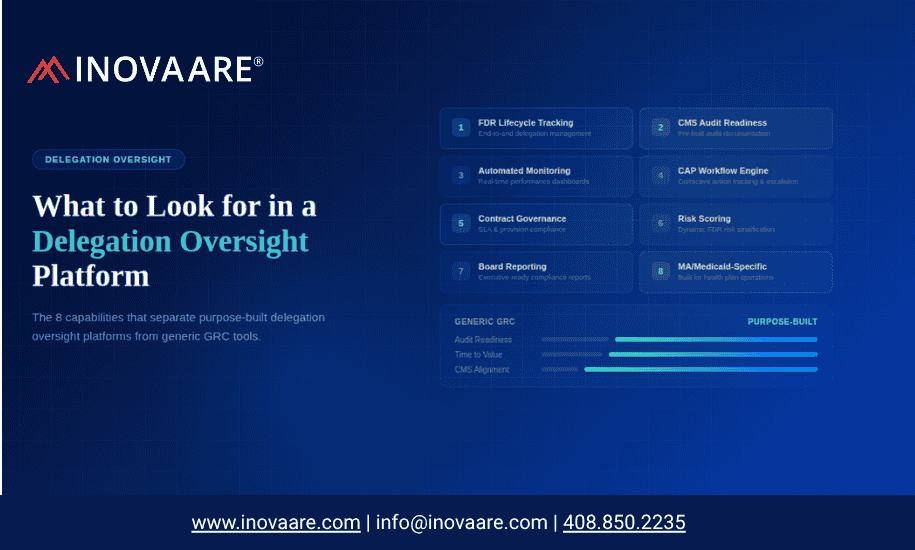
Generic vendor management tools were not built for CMS FDR requirements. Here’s how to evaluate delegation oversight platforms on the capabilities that actually matter — and the questions to ask in every demo.
If your compliance team has reached the point of evaluating delegation oversight platforms, you’ve probably already recognized the core problem: the combination of spreadsheets, shared drives, and email that manages your FDR/DE relationships is not producing the documentation we believe CMS expects to see in a program audit. The question now is how to evaluate alternatives without buying the wrong thing.
The market for vendor management and GRC software is crowded. Most tools can store documents. Many can assign tasks. Some have dashboards. But delegation oversight for a Medicare Advantage or Medicaid health plan is a specific operational and regulatory challenge, not a generic vendor management problem. The capabilities that we believe make a delegation oversight platform effective are precisely the ones that generic horizontal tools don’t have by default.
This guide gives you the evaluation framework, the specific capabilities to require, and the demo questions that separate tools built to address what we see as CMS compliance requirements from tools that will require years of configuration to approximate it.
CMS is now auditing all 550 Medicare Advantage contracts annually — up from approximately 60 per year. The 2024 Program Audit Report explicitly identified delegation oversight failures as a top deficiency. Plans that purchase a generic tool and spend 12 months configuring it will be audited before that configuration is complete. Purpose-built means ready on day one.
The 8 Capabilities That Separate Purpose-Built From Generic
Pre-Built CMS FDR Workflows — Not Configurable Templates
The pre-delegation determination process, the delegation repository structure, the SLA monitoring framework, the FDR audit workflow, and the CAP lifecycle need to reflect what we believe are CMS’s actual requirements, not generic vendor management concepts that need to be customized to approximate them. Look for platforms that ship with the healthcare-specific workflow logic already embedded, including by delegation type (PBM, UM, provider network, customer service) and by regulatory framework (Part C, Part D, Medicaid).
❌ Generic platforms require 6-18 months of configuration to approximate this ✓ Purpose-built: operational within weeks, not monthsSecure DE Portal — Not Just Internal-Facing Tracking
The most effective delegation oversight programs bring delegated entities into a shared compliance infrastructure — not just track them internally. A secure DE Portal allows delegated entities to submit compliance documents, respond to pre-delegation surveys, complete task assignments, and receive audit communications directly through the platform. This eliminates the email-based document collection fire drill and creates a timestamped, system-generated record of every vendor interaction that can be produced to an auditor on demand.
❌ Generic vendor portals handle document exchange but lack healthcare compliance context ✓ Purpose-built: DE Portal integrated with delegation workflow, monitoring, and CAP linkageContinuous SLA Monitoring With Configurable Tolerance Thresholds
Based on our reading of CMS’s 2024 audit findings, we believe routine, continuous monitoring is what CMS expects, not annual review alone. Look for platforms that allow you to define SLA metrics by entity and function type, set tolerance thresholds with automated alerts, and generate real-time scorecards that reflect current performance rather than last month’s report. The monitoring should be continuous, not periodic.
❌ Most GRC tools support manual reporting workflows, not continuous automated monitoring ✓ Purpose-built: automated alert at first breach with documented escalation pathNative Finding-to-CAP Linkage — No Manual Handoff
The audit trail we believe CMS needs to see runs from deficiency identification through corrective action initiation to validated closure, in a single, traceable chain. When FDR audit findings and CAPs live in separate systems, that chain breaks. Look for platforms where an audit finding automatically generates a CAP, assigns an owner, sets a resolution timeline, and requires evidence review before closure, all within the same system that conducted the audit.
❌ Point tools that handle only one stage of the lifecycle create manual handoff gaps ✓ Purpose-built: audit → finding → CAP is a single connected workflow with no manual bridgeUniverse Scrubber Integration for FDR-Submitted Data
Delegated entities that submit data to be included in your CMS universe files are one of the highest-risk points in your submission process. An FDR that misinterprets a data field definition can introduce errors that propagate through the plan’s universe submission — and the plan owns those errors. Look for platforms that integrate a universe scrubber at the entity level, allowing FDRs to validate their own data submissions before they enter your aggregation process.
❌ Generic GRC tools have no CMS universe data logic ✓ Purpose-built: FDR data validated at source before plan-level aggregationEmbedded AI That Understands Healthcare Compliance — Not Generic Automation
AI features in GRC platforms range from marketing language to genuinely useful compliance assistance. For delegation oversight, useful AI capabilities include anomaly detection in SLA performance data, natural language search across delegation documentation, auto-generated summary reports for executive and board reporting, and AI-assisted CAP analysis. Look for AI that is trained on healthcare compliance data and integrated into the delegation workflow — not a generic LLM wrapper bolted onto the interface.
❌ Generic AI features require significant prompt engineering to be useful in compliance contexts ✓ Purpose-built: AI trained on CMS compliance logic, embedded in delegation workflowsOn-Demand Audit Documentation — Not Reactive Reporting
When a CMS engagement letter arrives, you have days to begin producing documentation. Look for platforms that can generate a complete, audit-ready package for any FDR/DE entity — covering the complete delegation lifecycle from pre-del assessment through current monitoring status and open CAPs — in under an hour. This capability test is one of the best ways to distinguish platforms that are designed for auditors from platforms that require significant manual effort to produce audit-ready output.
❌ Manual processes and disconnected systems cannot produce complete documentation quickly ✓ Purpose-built: complete timestamped lifecycle documentation on demand for any entityMulti-Market Support — Medicare, Medicaid, and Marketplace
Health plans that operate across multiple CMS program lines need delegation oversight that reflects the different regulatory requirements of each market. In our experience, Medicare Advantage FDR requirements, Medicaid managed care delegation requirements, and ACA marketplace delegation standards have meaningful differences in their monitoring, documentation, and audit expectations. Generic tools typically don’t account for these differences; purpose-built platforms do.
❌ Single-market tools require workarounds for multi-line health plans ✓ Purpose-built: Medicare, Medicaid, Marketplace, and Group markets natively supportedThe Decision Matrix: Purpose-Built vs. Generic GRC
| Capability | Generic GRC / Vendor Mgmt | Inovaare Delegation Oversight |
|---|---|---|
| Pre-built CMS FDR workflow logic | ✗ | ✓ |
| Secure DE Portal for vendor interactions | ✗ | ✓ |
| Continuous SLA monitoring with auto-alerts | ✗ | ✓ |
| Native finding-to-CAP linkage | ✗ | ✓ |
| Universe scrubber integration for FDRs | ✗ | ✓ |
| Healthcare-specific AI embedded in workflows | ✗ | ✓ |
| On-demand audit-ready documentation | Partial | ✓ |
| Multi-market support (MA, Medicaid, Marketplace) | Partial | ✓ |
| HITRUST and HIPAA certified | Varies | ✓ |
| Operational within weeks, not months | ✗ | ✓ |
The Demo Scorecard: Questions to Ask Every Vendor
Use these questions in every platform demo. The answers will quickly separate tools that understand what we believe are CMS delegation requirements from tools that will need extensive configuration to approximate them.
Pre-Delegation & Repository
Monitoring & SLA Oversight
FDR Audit & CAP
Audit Readiness
After any delegation oversight platform demo, ask: “If CMS sent our plan an engagement letter tomorrow, how quickly could we produce audit-ready documentation for all of our FDR/DE entities using what we’ve seen today?” The answer to that question — including how much manual preparation would be required — will tell you more than any feature comparison.
What Purpose-Built Actually Means in Practice
The difference between a purpose-built delegation oversight platform and a configured GRC tool is the difference between a compliance process that generates its own evidence and a compliance process that requires someone to document what happened. Purpose-built means the workflow itself produces the audit trail — not as a byproduct, but as the primary output.
When a vendor submits a document through the DE Portal, the timestamp is automatic. When an SLA threshold is breached, the alert is automatic. When an audit finding is documented, the CAP initiation is automatic. When a CAP is closed, the evidence review gate is automatic. In each case, the system generates the documentation that makes oversight provable — not the compliance team working backward to reconstruct what occurred.
Health plans that have operated under the pressure of expanding CMS audit scope understand that the value of a purpose-built delegation oversight platform is not what it does on a routine day. It’s what it enables on the day the engagement letter arrives. That is the test worth optimizing for.
See Inovaare’s Delegation Oversight Platform in Action
Request a 30-minute live demo with Inovaare’s compliance specialists. Bring your demo scorecard questions — we’ll answer every one of them with the platform live on screen.
Schedule a Demo Explore the PlatformSources: CMS 2024 Part C and Part D Program Audit and Enforcement Report; Inovaare Delegation Oversight Module documentation. Performance statistics reflect expected outcomes based on platform capabilities and are representative of platform design targets.