
Health plan CIOs and compliance leaders have legitimate concerns about deploying AI in appeals and grievances workflows. “Autonomous agents” and “self-learning systems” are not what CCMS auditors don’t just test timeliness — they test whether your plan correctly identified what it received in the first place. Misclassifying a grievance as a coverage request, or an appeal as an inquiry, is one of the fastest paths to an ODAG finding. And it almost always traces back to your intake process.
The phrase “AI agents” has created two distinct reactions among health plan operations and IT leaders. The first: genuine interest in what AI-assisted automation could do for A&G throughput, classification accuracy, and timeliness compliance. The second: a deep wariness about what “autonomous” systems mean when the underlying workflows are CMS-regulated, when every case decision affects a Medicare beneficiary’s access to care, and when the audit consequences of a bad outcome are measured in civil monetary penalties and Star Rating impacts.
Both reactions are appropriate. The problem is that the AI vendor market has not been sufficiently specific about the distinction between AI that is safe for CMS-regulated A&G operations and AI that is genuinely dangerous in that environment. Here is that distinction, clearly laid out.
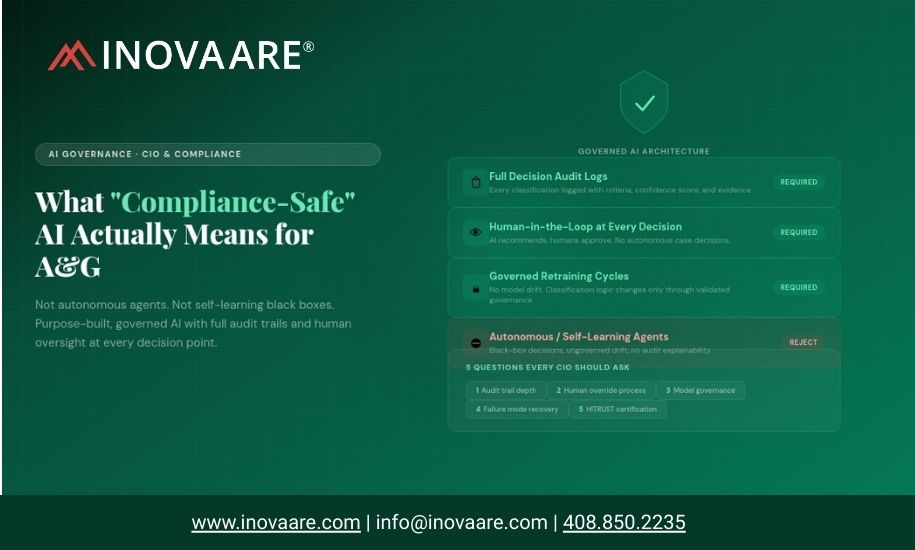
Autonomous agents that make clinical or coverage decisions without human review. Self-learning systems whose classification logic can drift without governed retraining cycles. “Black box” models whose decisions cannot be audited or explained to a CMS reviewer. Any AI component that, if it fails, creates a downstream compliance condition with no human backstop.
The Legitimate Concerns — and Why They’re Addressable
When health plan CIOs and compliance officers articulate their concerns about AI in A&G operations, they cluster around four categories. Each is legitimate. Each has a specific technical and governance answer in a purpose-built, compliance-designed system.
Unexplainable Decisions
If an AI agent classifies a case incorrectly, CMS expects the plan to explain what happened. A system that cannot produce an audit log of the classification reasoning is ungovernable in a CMS program audit context.
Full Decision Audit Logs
Every classification decision is logged with the specific criteria applied, the confidence score, and the document evidence used. Reviewers and compliance teams can inspect the reasoning for any case in the universe.
Automation Bias in Human Review
If human reviewers treat AI classifications as authoritative rather than advisory, erroneous classifications go uncorrected. This is a well-documented failure mode in AI-assisted clinical workflows.
Human-in-the-Loop by Design
Compliance-safe intake agents classify and route cases but do not finalize coverage decisions. Human review is not optional — it is structurally required before any decision affecting member benefits is issued.
Logic Drift on Regulatory Updates
CMS updates A&G guidance regularly. An AI system whose classification logic is not synchronized with current CMS guidance will classify cases against outdated criteria — creating systematic errors across the entire universe.
Governed Regulatory Sync
Classification logic is updated through a governed change process whenever CMS guidance changes — not through autonomous retraining. The plan controls when and how the logic changes, with validation before any update goes live.
PHI Exposure in AI Processing
A&G documents contain PHI. Any AI processing pipeline must maintain HIPAA compliance and HITRUST certification throughout the document handling, extraction, and storage workflow.
HITRUST-Certified Processing
Purpose-built healthcare AI platforms maintain HITRUST and HIPAA certification across the entire document processing pipeline — not just the storage layer. The AI processing itself meets the same security standards as the rest of the platform.
The Four Pillars of Compliance-Safe AI for A&G Operations
CMS does not currently prescribe specific AI governance frameworks for MA plan operations — but the existing regulatory requirements for A&G process documentation, universe accuracy, and audit readiness create a de facto standard for what compliant AI behavior must look like. A compliance-safe AI system for A&G intake must satisfy four structural requirements:
Deterministic, Not Probabilistic, Behavior
The AI must apply defined regulatory rules consistently and predictably. The same document, processed twice, must produce the same classification. Probabilistic systems that produce variable outputs on identical inputs are ungovernable in an audit context where the universe must be reproducible.
Explainability at the Case Level
Every classification, extraction, and routing decision must be explainable at the individual case level. When a CMS auditor asks “why was this case classified as a grievance rather than a coverage request?”, the system must produce a specific, reviewable answer that references the document content and the regulatory criteria applied.
Hard Handoffs to Human Review
No AI agent in the A&G intake pipeline should make a final determination that affects member benefits without a human reviewer in the decision chain. The AI handles classification, extraction, and routing. Humans review the case and make the determination. This isn’t a limitation — it is the required architecture for CMS compliance.
Change-Controlled Regulatory Updates
When CMS updates ODAG or CDAG guidance, the AI’s classification logic must be updated through a formal change management process — with validation, testing, and a documented effective date. Not through autonomous retraining. The plan must own the moment when new regulatory logic becomes active in its intake system.
Compliance-safe AI agents for A&G intake are best understood as compliance-trained digital operators that execute high-volume, rule-governed tasks — document classification, data extraction, expedited detection, case creation — with full auditability and mandatory human review before any decision that affects member benefits. They don’t replace compliance judgment. They remove the administrative volume that buries it in manual processing queues.
Why Generic AI Tools Fail in CMS-Regulated A&G Environments
The market for AI document processing tools is large and growing. Most of these tools are horizontal — built for general business document processing and adapted for healthcare use cases through configuration. The problem for A&G intake is specific: the classification logic that matters isn’t pattern-matching on document language. It’s the application of regulatory definitions from 42 CFR 422 Subpart M and 42 CFR 423 Subpart M.
A generic document AI that has been trained on general business document types will classify a member complaint about access to care as a “complaint” — because that’s the surface language. A purpose-built A&G intake agent applies the CMS distinction between grievances (expressions of dissatisfaction about the plan’s service or decision) and coverage requests (requests for a service determination) — and classifies accordingly. Those are different regulatory case types with different timeliness standards and different member rights. Getting this distinction wrong on a horizontal AI tool is an ODAG finding waiting to happen.
When evaluating any AI platform for A&G intake, ask the vendor: “Show me the specific regulatory framework your classification logic was built on.” A purpose-built healthcare payer AI will point to 42 CFR 422/423, CMS ODAG protocol definitions, and BPC guidelines. A horizontal AI tool will point to general NLP training data or document type libraries. The answer tells you immediately whether the classification logic is regulatory-grade or configuration-dependent.
What State AI Regulations Are Adding to the Picture
Federal AI governance for healthcare payers is still evolving, but state-level AI regulations are creating new compliance obligations that health plans must factor into their AI platform evaluations. Colorado’s Consumer Protections in Interactions with Artificial Intelligence Systems Act applies to AI used in healthcare decisions and requires bias protections, methodology disclosures, and appeal rights for AI-generated decisions. Texas passed legislation in 2025 prohibiting utilization review agents from using automated decision systems to issue adverse determinations without clinician review.
This regulatory trajectory reinforces the compliance-safe AI architecture described above: human-in-the-loop review for coverage decisions, explainable AI reasoning, and governed change management for any AI component that influences member benefit determinations. Health plans that deploy AI intake agents built on this architecture are ahead of the regulatory curve — not just for today’s requirements, but for the state and federal AI governance requirements that will follow.
The Five Questions Every CIO Should Ask Before Approving an A&G Intake AI Platform
Inovaare’s AI intake agents are built on CMS regulatory definitions, produce full audit logs at the case level, route low-confidence classifications to human review automatically, and are updated through a governed change management process synchronized with CMS guidance updates. The platform is HITRUST and HIPAA certified across the entire document processing pipeline — not just the data storage layer. Every classification decision is explainable to a CMS reviewer.
See How Inovaare Builds Compliance-Safe AI for CMS-Regulated A&G
Request a technical walkthrough of Inovaare’s AI intake architecture — including audit log demonstration, classification logic review, and CMS regulatory mapping. Designed for CIO and compliance leader audiences.
Request Technical Demo Explore AI AgentsSources: Colorado Consumer Protections in Interactions with AI Systems Act; Texas 2025 utilization review AI legislation; Health Affairs January 2026 analysis of AI use in utilization review; CMS ODAG Audit Protocol; HITRUST certification framework.