
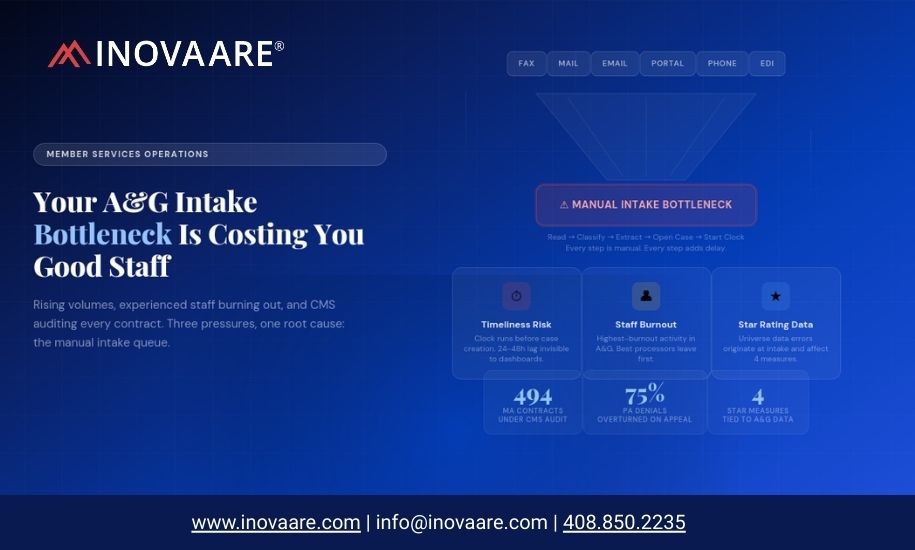
Appeals and grievances volumes are rising across Medicare Advantage. Staff who process them are burning out and leaving. CMS is auditing every contract now instead of a rotating subset. These three pressures share a single root cause: the manual intake bottleneck at the front of your A&G workflow. Here’s what it actually costs, and what it looks like to fix it.
Every health plan compliance and operations leader knows the A&G function is under pressure. What fewer leaders have mapped systematically is how much of that pressure originates in a single place: the intake queue — the process of receiving, reading, classifying, extracting data from, and opening a case for every incoming appeal, grievance, coverage determination request, CTM complaint, and provider dispute that arrives at the plan.
That intake process, in most health plans today, is predominantly manual. A staff member receives a document — by fax, mail, email, or web portal. They read it. They determine what type of case it is. They extract the relevant data fields. They open a case in the plan’s case management system. They start the timeliness clock. And then they move to the next document.
At low volume, this is manageable. At the volumes that mid-to-large Medicare Advantage plans now process, it is a structural liability — for compliance, for operations, for staff retention, and increasingly for Star Ratings.
The Three Ways the Intake Bottleneck Destroys Value
1. It creates timeliness deficiencies before a single reviewer touches the case
CMS’s timeliness standards for ODAG and CDAG are measured from the moment of receipt — not from when the case was opened, assigned, or acknowledged. When intake processing takes hours or days due to manual queue backlogs, the timeliness clock has been running the entire time. A case that arrives at 4 PM on Friday and isn’t opened until Monday morning has already consumed 60-plus hours of a 72-hour expedited window.
This is how plans that believe they have good review and resolution processes still fail timeliness audits. The problem isn’t in the review or the decision — it’s in the hours between receipt and case creation that no one is monitoring because they fall outside the case management system’s tracking scope.
CMS calculates timeliness from the date and time the plan received the request — not the date the case was created in your system. If your intake process has a 24-48 hour lag between receipt and case creation, that lag is consuming your timeliness buffer before any reviewer begins their work. It won’t appear in your case management dashboard, but it will appear in your ODAG audit universe.
2. It burns out your most experienced A&G staff
A&G intake work is cognitively demanding. Every document is different. Every case type has different regulatory definitions. Expedited requests require immediate recognition and routing. Documents arrive from members, providers, attorneys, and AORs in varying formats with varying completeness. Making the right classification decision repeatedly, across hundreds of documents per day, is exhausting in a way that simpler data entry work is not.
Health plan A&G teams report that intake processing is consistently identified as the highest-burnout activity in the department — not because it is physically demanding, but because the cognitive load of classification decisions at volume, combined with the compliance consequences of error, creates a pressure environment that experienced staff increasingly seek to avoid. The result is a retention problem that is structural, not motivational: plans lose their best intake processors to other roles, replace them with less experienced staff, and watch classification error rates rise.
3. It creates universe data quality problems that affect Star Ratings independently of audit outcomes
CMS uses A&G universe data — submitted by plans to the IRE (Maximus) — as the basis for four Star Rating appeal measures. The agency cross-references this universe data against its own program audit findings and IRE data. When it identifies discrepancies that suggest universe data integrity issues, it can flag those contracts as having invalid measure data that cannot be used in Star Ratings.
Universe data quality originates at intake. If cases are classified incorrectly, counted incorrectly, or have incorrect receipt timestamps, those errors propagate into the universe submission. A classification error at intake becomes a Star Rating data integrity problem three months later when the universe is submitted — and the plan has no systematic way to detect the error in between.
What the Intake Bottleneck Actually Looks Like Day-to-Day
Documents arrive by fax and mail in unpredictable formats. Staff reads each one, determines case type, extracts fields manually, and creates a case. Queue backlogs form by mid-afternoon. Late-day faxes aren’t processed until the next business day.
Timeliness clocks running while documents sit unprocessed. Classification errors from fatigued staff applying inconsistent criteria. Missing expedited indicators. Incomplete case records entering the review workflow.
Cases classified and opened at receipt. Expedited requests identified automatically. Timeliness clocks started from documented receipt timestamps. Universe data that accurately reflects what was actually received.
The Before/After: Manual Intake vs. AI Agent-Assisted Intake
The AI Agents That Solve the Intake Problem
Purpose-built AI agents for A&G intake are not general-purpose document processing tools repurposed for healthcare. The distinction matters because the classification logic they must apply is specific to CMS regulatory definitions — not generic document type patterns. An agent that correctly classifies a “coverage request” versus a “grievance” must understand the regulatory definitions in 42 CFR 422 Subpart M, not just the surface language of the document.
The operational AI agents that address the A&G intake bottleneck work as a coordinated pipeline:
Document Classification Agent
Receives incoming documents across all channels and classifies them as appeal, grievance, coverage determination, CTM complaint, AOR submission, or provider dispute — using CMS regulatory criteria, not keyword matching.
Data Extraction Agent
Extracts structured case data from unstructured documents: issue description, claim number, event date, member ID, respondent, issue type, and AOR information — populating the case record without manual entry.
Case Prioritization Agent
Assesses urgency by detecting expedited language, time-sensitive clinical indicators, and regulatory priority triggers. Routes expedited cases immediately and flags borderline cases for human review.
Data Enrichment Agent
Auto-populates case category, sub-category, member and AOR details by cross-referencing the incoming document against member records, claim data, and plan policy — so the reviewer receives a complete case, not a shell.
The most common CIO concern about AI in A&G operations isn’t “can it classify documents?” — it’s “can it fail safely?” Purpose-built A&G intake agents are designed for deterministic, auditable behavior. Every classification decision is logged with the reasoning. Human-in-the-loop review is triggered for low-confidence cases. The system doesn’t replace compliance judgment — it removes the administrative volume that buries it.
The Compounding ROI: Why Fixing Intake Fixes Three Problems at Once
When health plan compliance and operations leaders model the ROI of AI intake agents, they typically calculate on the basis of one benefit: FTE hour reduction. That’s real — but it understates the case significantly.
Fixing intake also fixes timeliness compliance by eliminating the receipt-to-case-creation lag. It also fixes universe data quality by ensuring every case has an accurate receipt timestamp and correct initial classification. It also fixes staff retention by removing the highest-burnout activity from experienced A&G processors and redirecting them to higher-judgment work. And it fixes Star Ratings exposure by eliminating the universe data integrity errors that originate from classification inconsistency.
The plans that model intake AI against four simultaneous cost centers — labor, timeliness findings, Star Ratings penalty exposure, and retention/recruitment costs — consistently find the business case is three to five times larger than the FTE calculation alone suggests.
The most effective framing for the A&G intake AI business case is not “we’re deploying AI.” It’s “we’re eliminating the single process that creates our biggest audit risk, our biggest retention problem, and our biggest Star Ratings data quality exposure — simultaneously.” The technology is the mechanism. The business outcome is risk reduction across three separate compliance and operational domains.
Implementing AI Intake: The Evaluation Criteria That Matter
Not every AI document processing tool is suitable for CMS-regulated A&G intake. When evaluating solutions, health plan compliance and operations leaders should ask:
- Is the classification logic trained on CMS regulatory definitions or on general document type patterns? Generic document AI misclassifies healthcare regulatory cases at rates that create ODAG audit risk.
- Does it support all intake channels — fax, mail, email, web portal, and EDI — or only structured electronic submissions? Most A&G volume still arrives by fax.
- Is the receipt timestamp captured at document arrival or at case creation? The distinction determines whether your timeliness clock is CMS-accurate.
- Does it integrate with your case management system to create complete case records, or does it produce output that requires a second manual step?
- Is every classification decision logged and auditable with the reasoning visible to reviewers and compliance teams?
- Does it handle low-confidence cases with human review triggers rather than defaulting to a classification that may be wrong?
See Inovaare’s AI Intake Agents in Action
Inovaare’s purpose-built A&G intake agents are trained on CMS regulatory criteria and integrate directly with your case management workflow — classifying, extracting, enriching, and prioritizing cases from the moment of receipt. No manual processing. No intake lag. No universe data risk.
Explore the Platform Request a DemoSources: CMS 2024 Part C and Part D Program Audit and Enforcement Report; CMS ODAG Industry-Wide Timeliness Monitoring documentation; ATTAC Consulting Group ODAG guidance (2025); AMA Prior Authorization Survey (2024).