
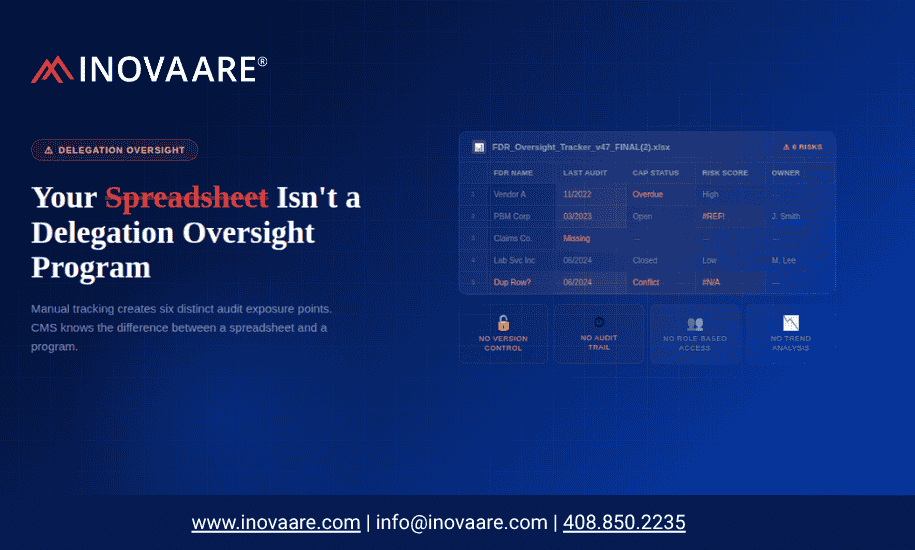
Health plans that manage FDR oversight in Excel and email have a documentation problem they won’t discover until it’s too late. Here’s exactly how manual delegation management creates audit exposure — and what a defensible process actually looks like.
Every compliance officer who manages delegation oversight in spreadsheets believes their process works — because they know what’s in the spreadsheet. They know which vendors are current on their compliance attestations. They know which SLAs were missed last quarter. They know which corrective actions are pending closure.
The problem is that CMS auditors don’t have access to your spreadsheet. And even if they did, in our view, a spreadsheet cannot prove that monitoring happened continuously, that escalations occurred within required timeframes, or that corrective actions were validated rather than self-certified. The fundamental limitation of manual delegation oversight isn’t the tool. It’s what the tool cannot produce: a timestamped, auditable, automatically-generated record of oversight that exists independent of any individual’s memory or effort.
CMS’s 2024 Program Audit Report found that sponsors’ internal monitoring processes failed to detect untimely notifications to enrollees when delegated entities misinterpreted regulatory requirements. In our reading, the issue wasn’t that plans were negligent; it was that their monitoring systems weren’t designed to catch this type of failure in real time. A spreadsheet reviewed monthly cannot catch a problem that occurs in week two.
The Six Ways Manual Oversight Creates Audit Exposure
The Document Collection Fire Drill
Every year, someone on the delegation oversight team sends a batch of emails to your FDRs requesting updated compliance attestations, training rosters, and policy documents. Some vendors respond quickly. Others take weeks. Some never respond without multiple follow-ups. By the time you’ve collected everything, the documents from the first responders are already two months old.
During a CMS audit, the auditor asks: when did each vendor submit their compliance attestation for the current coverage year, and what process does the plan use to track overdue submissions? In our view, the email thread you’re trying to reconstruct is not a process. It is evidence that you don’t have one.
No documented process for tracking compliance document collection from delegated entities. Incomplete document packages at time of audit. Cannot demonstrate systematic oversight of vendor compliance program effectiveness.
The SLA Breach That Didn’t Get Escalated
Your PBM’s timeliness SLA requires 95% of prior authorization decisions within 72 hours. The compliance team reviews the monthly report from the vendor. In March, performance slipped to 91%. The report was filed. No escalation occurred because 91% was close to the threshold and the team was managing other issues that month. In September, a CMS audit request arrives asking for documentation of monitoring and corrective action for all SLA breaches in the current coverage year.
There is a March report showing 91% performance. There is no escalation record. There is no CAP. There is a finding.
Monitoring data exists but no documented escalation process. SLA breach identified but not addressed through a formal corrective action path. CMS finding: monitoring program insufficient to ensure compliance.
The CAP That Was Closed on Paper
Your annual FDR audit of the utilization management vendor finds three deficiencies: insufficient training documentation for new staff, SLA breach in notification timeliness, and a gap in the vendor’s quality monitoring process. You issue a CAP in a Word document. The vendor responds by email in six weeks: “All corrective actions have been completed.” You close the CAP in your tracker.
Fourteen months later, the next annual audit finds the same three deficiencies. The CAP closure was based on the vendor’s self-certification. No evidence was required. No evidence was reviewed. CMS now sees a plan that issues CAPs but cannot demonstrate that corrective actions were actually effective — a repeat finding that is significantly more damaging than the original deficiency.
Repeat findings in consecutive audit cycles. CAP closure not supported by evidence review. Pattern of deficiency suggests corrective action process is nominal rather than effective — one of the most serious CPE findings CMS can make.
The Missing Pre-Delegation Documentation
Three years ago, the plan contracted with a new customer service vendor and delegated member call handling. The business owner who managed that vendor relationship completed a due diligence review via phone calls and email. That business owner left the organization 18 months ago. CMS asks for the pre-delegation assessment for the customer service vendor.
There is an executed contract. There is no pre-delegation assessment, because the process wasn’t standardized and the documentation wasn’t required at the time. We believe CMS expects to see a formal qualification process for every entity to which a regulated function was delegated, regardless of when the relationship started.
No documented pre-delegation qualification process for active delegated entity. Cannot demonstrate that the plan assessed the vendor’s compliance capability before delegating a CMS-regulated function. Finding in CPE audit domain.
What Manual Oversight Cannot Produce
The common thread across these scenarios isn’t negligence or incompetence. It’s a structural limitation: manual, distributed oversight processes are incapable of producing the specific type of documentation that we believe CMS needs to confirm oversight occurred. Here’s a direct comparison:
| Oversight Requirement | Spreadsheet / Email Approach | Purpose-Built Platform |
|---|---|---|
| Pre-delegation assessment documentation | Informal email exchange; varies by business owner; no standard criteria | Standardized task surveys with documented vendor responses and formal approval records |
| Compliance document collection from FDRs | Annual email campaign; no tracking; completion depends on follow-up effort | Secure DE Portal with tracked submissions, automated reminders, and timestamped receipts |
| SLA monitoring & breach detection | Monthly vendor reports reviewed manually; breaches detected when someone notices | Continuous monitoring with defined thresholds and automated alerts at first breach |
| Escalation documentation | Email thread; may not be retained; no timestamped escalation record | System-generated escalation log tied to specific SLA metric and threshold breach |
| CAP management & closure validation | Separate tracker; vendor self-certifies completion; no evidence review gate | Auto-linked CAPs with assigned owners, evidence requirements, and validated closure |
| Audit-ready documentation production | Hours or days to compile across systems; gaps likely upon reconstruction | On-demand report for any FDR/DE with complete timestamped history |
The Specific Risks Health Plans Carry
Beyond the audit findings themselves, manual delegation oversight creates four categories of operational risk that compound over time:
People-Dependency Risk
When delegation oversight lives in an individual’s spreadsheet and memory, it leaves with them. Institutional knowledge about vendor relationships, informal monitoring agreements, and historical findings disappears with turnover — leaving successors to reconstruct what was never systematically captured.
Latency Risk
A monitoring process that surfaces problems at quarterly review catches issues weeks after they begin. In that window, member harm may have already occurred, CMS regulatory timelines may have been missed, and the plan’s corrective action is retroactive rather than preventive.
Reconstruction Risk
When CMS requests documentation, plans have limited time to respond. Evidence that must be reconstructed from email archives and inconsistent spreadsheets is both time-consuming and inherently incomplete. What cannot be reconstructed becomes an admission of absence.
Repeat-Finding Risk
CAPs closed without validated evidence review get repeated. In our assessment, repeat findings in consecutive audit cycles are likely treated by CMS as evidence of systemic compliance program failure, significantly more damaging than the original deficiency and much harder to remediate.
The Transition from Manual to Systematic Oversight
The goal of a delegation oversight platform isn’t to replace the compliance team’s judgment. It’s to make the compliance team’s oversight provable — by creating systematic, timestamped records of the work that is already happening.
Pre-delegation assessments that are currently conducted informally become standardized surveys sent through a portal that logs submission date, vendor responses, reviewer actions, and approval decisions. SLA monitoring that is currently manual becomes automated collection with configurable thresholds and system-generated alerts. CAP tracking that lives in a separate spreadsheet becomes auto-linked to the audit findings that generated them, with evidence gates that prevent closure without substantiation.
The operational work of delegation oversight doesn’t fundamentally change when you move from manual to platform-based management. What changes is the documentation output. Every action taken, whether a document is reviewed, a threshold is breached, an escalation is sent, or a CAP is closed, generates a timestamped, system-native record that exists independent of any individual’s memory or effort. In our view, that record is what makes oversight defensible when CMS auditors come calling.
The plans that are best positioned for the current CMS audit environment are not necessarily the ones doing the most oversight. They are the ones doing systematic oversight — where the process itself generates the evidence, rather than the team having to reconstruct it when the engagement letter arrives.
See What Systematic FDR Oversight Looks Like
Inovaare’s Delegation Oversight platform replaces spreadsheet-based FDR management with a purpose-built lifecycle system — from pre-delegation through CAP closure — where every action generates audit-ready documentation by default.
Explore the Platform Request a DemoSources: CMS 2024 Part C and Part D Program Audit and Enforcement Report (July 2025). Scenarios in this article are composite illustrations based on common delegation oversight gaps identified across Medicare Advantage compliance programs.